Quick answerChimney flashing is a two-part system: base (or step) flashing integrated into the shingle courses along the sides of the chimney, and counter-flashing embedded into the mortar joints of the chimney masonry that overlaps the base flashing. This two-layer design allows the chimney to move independently of the roof deck during thermal expansion without breaking the seal—critical because masonry chimneys and wood roof framing expand and contract at different rates.
Chimney flashing is responsible for sealing the joint where one of the most structurally complex roof penetrations meets the roofing surface, and it is one of the most common sources of serious water damage in Wichita homes. When chimney flashing fails—whether from age, storm displacement, or improper original installation—water enters a path that runs directly down the masonry and can saturate insulation, rot framing, and damage ceilings before any interior sign appears. Knowing when flashing repair is warranted, what a proper repair involves, and how long correctly installed flashing should last helps Wichita homeowners make timely decisions that prevent the cascade of secondary damage that turns a modest flashing repair into a major interior restoration project.
What Is Chimney Flashing and How Does It Work?
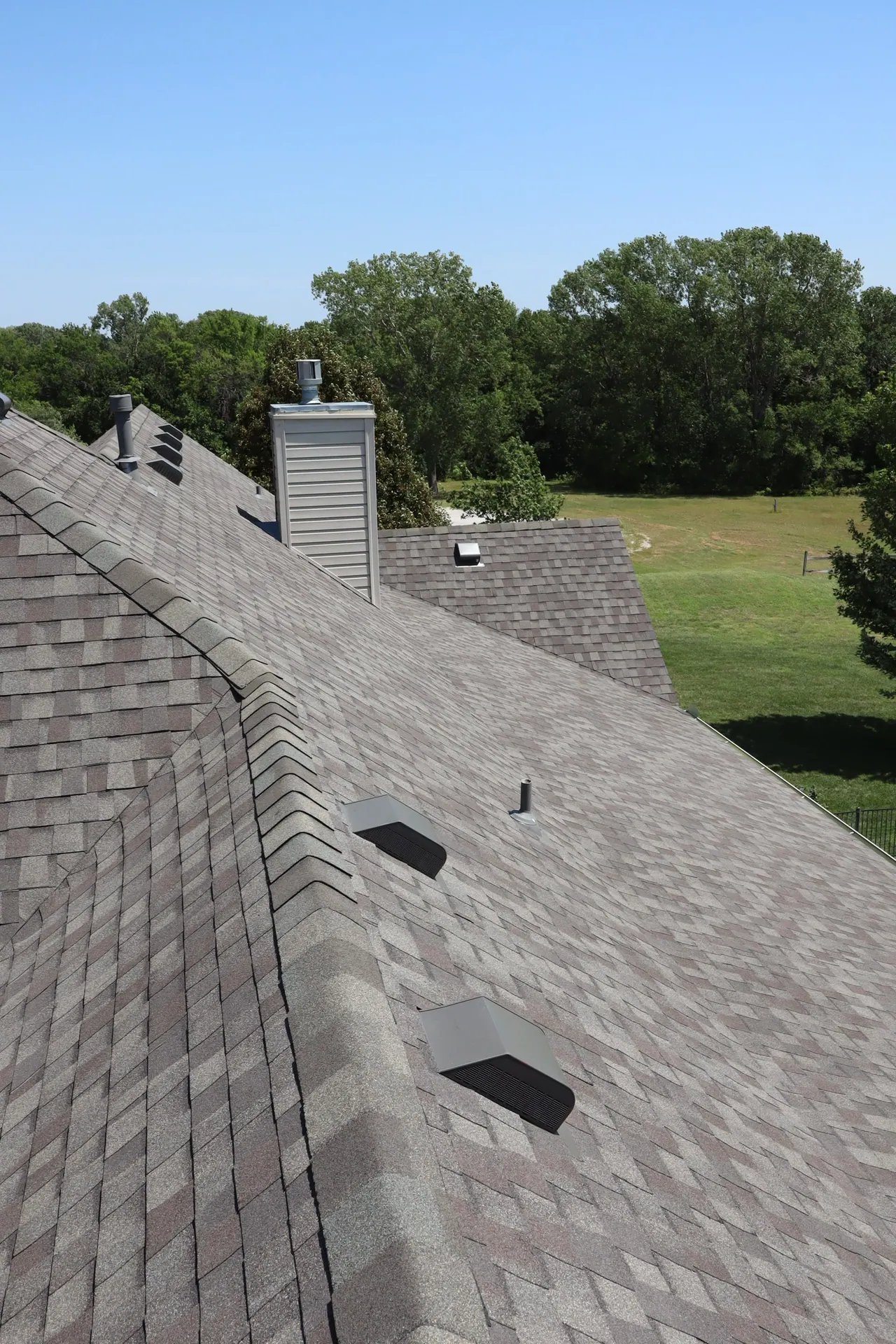
Chimney flashing is a two-part system: base (or step) flashing integrated into the shingle courses along the sides of the chimney, and counter-flashing embedded into the mortar joints of the chimney masonry that overlaps the base flashing. This two-layer design allows the chimney to move independently of the roof deck during thermal expansion without breaking the seal—critical because masonry chimneys and wood roof framing expand and contract at different rates. A saddle or cricket is also required on the uphill side of chimneys wider than 30 inches to divert water around the chimney base rather than pooling behind it. When any component of this system fails—sealant between counter and base flashing deteriorates, mortar joints holding counter-flashing crack, or step flashing lifts—water enters at the chimney-roof junction. Contact the Roof Repair in Wichita team for a chimney flashing evaluation if you have any concerns about your current system.
Worried about your roof?Wichita Roofing Pros will check it for free and explain what we find in plain words.Book a Free Inspection or call (316) 742-1900
What Are the Signs That Chimney Flashing Needs Repair in Wichita?
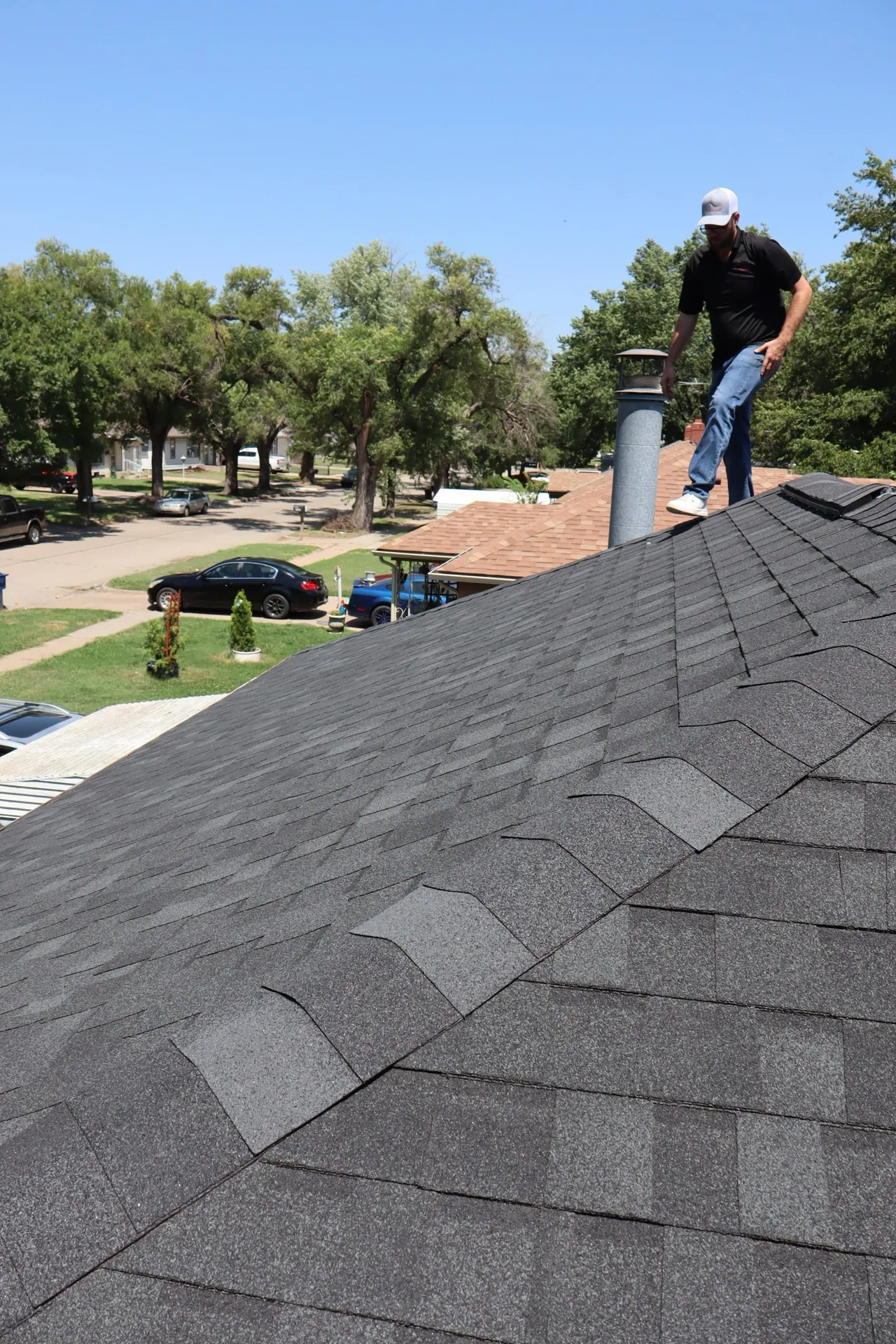
The clearest interior sign is water staining on the ceiling or wall directly adjacent to the chimney, or staining on the chimney face inside the home. In the attic, staining on rafters or decking boards that runs toward the chimney base indicates an active or past flashing leak. From the roof, visible signs include counter-flashing that has pulled free from mortar joints and is visibly lifted or gapped, base step flashing that is buckled or rusted, and sealant beads at the flashing edges that are cracked, missing sections, or have pulled away from either the masonry or metal surface. Wichita’s spring hail events can physically dent aluminum flashing and break sealant continuity in one storm, so post-storm chimney inspections are a recommended practice. Any visible gap between flashing and masonry is an active or imminent leak pathway. The Free Roof Inspection includes a close-up chimney flashing assessment as part of the standard scope.
Book a Free Inspection or call (316) 742-1900 What Are the Signs That Chimney Flashing Needs Repair in Wichita?
How Do Wichita’s Weather Conditions Accelerate Flashing Failure?
Several aspects of Wichita’s climate work against chimney flashing longevity. Thermal cycling is intense: masonry chimney surfaces can reach 140°F on summer afternoons and drop below freezing in winter—a differential that drives repeated expansion and contraction at the flashing-to-masonry joint. Kansas freeze-thaw cycles are particularly damaging to mortar joints that hold counter-flashing; water infiltrates cracked mortar, freezes, expands, and further fractures the mortar, loosening the flashing anchor. The high-wind environment documented by the National Weather Service Wichita office can physically lift and displace flashing tabs on exposed chimney sides. Hail impact causes surface denting in aluminum flashing that can open micro-cracks at bends. A chimney flashing system that was marginal at installation may last five to eight years before obvious failure, while a well-installed system typically achieves 20 to 25 years in Wichita conditions.
What Does a Proper Chimney Flashing Repair Involve in Wichita?
A correct chimney flashing repair is more involved than applying a bead of sealant around the chimney perimeter—a common shortcut that provides temporary relief at best and false confidence at worst. A professional repair begins with removing shingles on all four sides of the chimney to expose the existing flashing system. Step flashing that is corroded, improperly lapped, or lifted is removed and replaced with new galvanized steel or aluminum material integrated into the shingle courses with proper overlap dimensions. Counter-flashing embedded in mortar joints is inspected; if mortar is cracked or the flashing is no longer mechanically retained, mortar is cut out, flashing is re-embedded or replaced with reglet-mounted counter-flashing, and mortar is repointed. Ice-and-water shield is applied at the chimney base before new flashing and shingles are installed. The sealant at the overlap joint between base and counter-flashing is applied as a last step—not as the primary seal. The Leak Detection & Repair team performs chimney flashing repairs to this standard, not the sealant-only shortcut.
When Does Chimney Flashing Need Full Replacement Rather Than Repair?
Repair is appropriate when the flashing metal is structurally sound but the sealant, mortar joints, or individual step flashing pieces have failed. Full replacement is warranted when: the base flashing metal is corroded through or significantly thinned, the step flashing was not properly integrated into shingle courses during original installation (a common problem in older Wichita construction), the saddle or cricket behind the chimney is missing or has failed and needs to be built out, or the roof is being replaced and the existing flashing is old enough that leaving it in place risks a new leak within a few years. Replacing flashing during a re-roofing project adds modest cost but avoids the expense of opening a freshly shingled roof to address flashing failure two years later. The Full Tear-Off & Replace service includes new chimney flashing as part of the standard project scope.
How Much Does Chimney Flashing Repair Cost in Wichita?
Chimney flashing repair costs in Wichita depend on the scope of work and the number of roof penetration sides involved. A sealant-only re-seal on an otherwise intact flashing system runs $150 to $350. Partial step flashing replacement on one or two sides of a standard chimney, including shingle removal and replacement, ranges from $350 to $750. A full four-sided flashing replacement on a standard two-foot by three-foot chimney runs $600 to $1,400 depending on pitch and access. Chimney saddle or cricket installation adds $300 to $700 depending on size and complexity. Where masonry repointing is also required, the total can reach $1,500 to $2,500. These figures reflect Sedgwick County labor rates and assume a separate mobilization; work performed during a larger re-roofing project typically costs less per component. Reach out to Residential Roofing for a written estimate on your specific chimney configuration.
Does Chimney Flashing Failure Qualify as an Insurance Claim in Wichita?
Insurance claims related to chimney flashing hinge on the cause of failure. Flashing damage that results directly from a covered storm event—such as hail impact that dented and cracked the metal, or wind that physically lifted and displaced counter-flashing tabs—may be covered subject to your deductible. Flashing failure due to age, mortar deterioration, or original installation defects is typically classified as maintenance-related and excluded. The challenge is that storm events can accelerate pre-existing marginal flashing failures, making cause determination contested. Documenting chimney flashing condition immediately after any significant hail or wind event with dated photographs is the most effective way to support a potential claim. The Insurance Claim Replacement team is experienced with this documentation process and can advise on claim viability before you contact your adjuster.
How Long Should Properly Installed Chimney Flashing Last in Wichita?
Galvanized steel step flashing properly integrated with shingles and paired with copper or stainless counter-flashing installed in properly cut reglets should last 20 to 30 years in Wichita conditions. Aluminum flashing—more common in budget installations—runs 15 to 20 years before corrosion and fatigue cracking become problematic, particularly at the thermal cycling joints adjacent to masonry. The weakest point in almost every system is the sealant at the base-to-counter-flashing overlap, which typically needs refreshing every 7 to 10 years even on well-installed systems. Wichita Roofing Pros serves homeowners across the metro area including Derby, Maize, and Augusta. The team’s practical field knowledge across Sedgwick County projects informs chimney flashing recommendations specific to each home’s construction type and chimney configuration.
How Kansas weather turns a small leak into a big repair
Hot summers dry out sealants and rubber boots, winter freeze-thaw opens gaps, and spring storms push rain sideways. A drip that shows up once a year can still be soaking decking and insulation every time it rains hard.
Leak warning signs inside and outside your home
Water travels before it shows up, so the stain is rarely right under the problem. Watch for these signs.
- Brown rings or bubbling paint on ceilings
- Damp or musty smell in the attic
- Daylight visible through attic boards
- Dark streaks on rafters or decking
- Cracked or lifted pipe boots
- Rusted or loose flashing at chimneys and walls
- Shingles that feel soft underfoot (reported by a pro)
- Peeling exterior paint near roof edges
What to do the moment you find a leak
A few quick steps limit the damage while you wait for the inspection.
- Contain the water. Buckets, towels and moved furniture.
- Relieve a bulging ceiling safely. Puncture only if it is safe, with a bucket underneath.
- Photograph it. Inside stains and any outside damage.
- Call for a tarp if needed. Emergency tarping stops more water while repairs are planned.
- Book a leak inspection. We trace the source, not just the stain.
Leak repair mistakes that cost more later
- Caulking over a leak without finding the source
- Painting over a ceiling stain
- Ignoring a drip that only appears in heavy storms
- Replacing drywall before the roof is fixed
- Skipping an attic check for wet insulation
What affects the cost of a leak repair
Price depends on the source, roof access and pitch, the material, and whether decking or insulation got wet. A pipe-boot or flashing repair is very different from a repair that needs decking replaced. You get the scope and price in writing after the inspection.
From our work: Wood Shake Leak Tarping
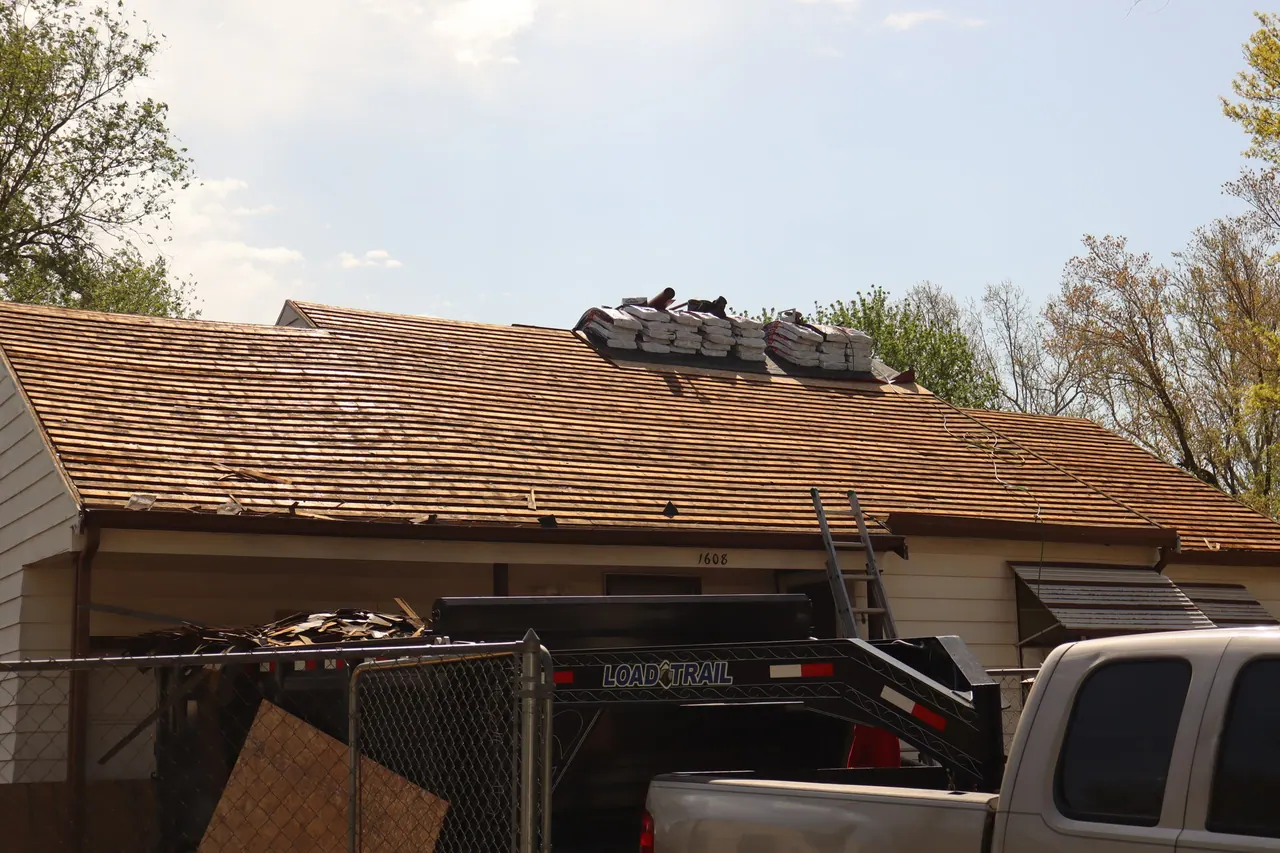
Dan tarps active leak spots on a wood shake roof while the homeowner’s insurance claim is underway, keeping interior damage from getting worse until the roof can be replaced.
Watch: Wood shake roof leak tarping
When Should Chimney Flashing Be Repaired in Wichita? The honest answer depends on your roof’s age, material and the damage we can document. A free inspection from Wichita Roofing Pros gives you photos, a plain-English explanation and a written next step — with no obligation. Hablamos Español.
Schedule a Free Roof InspectionCall (316) 742-1900Frequently Asked Questions About Chimney Flashing Repair in Wichita KS
Can I seal chimney flashing myself with roofing caulk in Wichita?
DIY sealant application to visible gaps around chimney flashing is a short-term temporary measure at best. Roofing caulk and sealants applied over existing failed material, without addressing the mechanical failure of the flashing assembly beneath, typically last one to two seasons before re-opening. More importantly, sealant cannot compensate for missing or improperly installed step flashing—the more common root cause. Professional repair that addresses the underlying flashing system provides a repair that lasts 10 or more years rather than one to two.
What happens if I ignore chimney flashing damage in Wichita?
Water entering at a chimney flashing failure follows a predictable path: first saturating the wood framing directly adjacent to the chimney, then moving horizontally along rafters and the underside of decking, then penetrating ceiling drywall. A leak that begins in spring and runs through an entire Wichita storm season without repair can require ceiling replacement, framing sistering, and insulation replacement in addition to the flashing repair itself—easily multiplying total repair cost by three to five times compared to addressing the flashing failure early.
How do I know if my chimney needs a cricket or saddle in Wichita?
If your chimney is wider than 30 inches measured perpendicular to the roof slope, building code and best practice require a cricket or saddle on the upslope side to divert water around the chimney. You can measure your chimney width from the roof surface. If a cricket is absent and the chimney is wide enough to require one, water pools behind the chimney during rain events and accelerates flashing failure and masonry deterioration at the back face significantly faster than on a properly cricket-equipped chimney.
How often should chimney flashing be inspected in Wichita?
Annually is the recommended interval, with an additional inspection after any significant hail or straight-line wind event. The practical approach for most Wichita homeowners is to include chimney flashing as part of a general roof inspection every two to three years plus an immediate visual check—looking for displaced or lifted counter-flashing from ground level with binoculars—after major storms. If the house is more than 15 years old and the flashing has never been replaced, a professional close-up inspection is warranted regardless of whether symptoms are present.
Does chimney flashing need to match the existing shingle color in Wichita?
No. Chimney flashing is a functional system component, and its metal color has no bearing on performance. Galvanized steel weathers to a neutral gray. Copper flashing, which is premium but more durable, weathers to a distinctive green patina over time. The shingles surrounding the chimney should match the existing roof for aesthetic consistency, but the flashing itself is not a color-matched component.
On Wichita roof checks, one practical pattern we look for is whether the damage lines up with the storm direction, roof slope, attic moisture, and nearby exterior conditions. That extra context helps separate a small surface issue from damage that can turn into leaks during the next heavy rain.
Can a roof leak be repaired in winter?
Often, yes. Many repairs can be done on dry, mild days, and emergency tarping can protect the home until then.
Is a small leak an emergency?
Any active leak should be addressed quickly. Small leaks soak decking and insulation and can lead to mold.
Do you offer emergency tarping?
Yes. Call (316) 742-1900 if water is coming in.