Quick answerA roof soft spot is a section of roof decking—the structural panel layer between the framing and the shingles—that has lost rigidity due to moisture damage, biological decay, or delamination. Most Wichita homes built in the last 50 years use oriented strand board (OSB) or plywood as decking material.
Stepping onto a roof and feeling the decking give underfoot is one of the more unsettling discoveries a Wichita homeowner or inspector can make. A soft spot on a roof is not a minor cosmetic issue—it almost always indicates that the structural layer beneath the shingles has been compromised by moisture intrusion, prolonged trapped humidity, or in more severe cases, active rot that has spread into the framing below. How urgently the problem requires attention depends on the size of the affected area, the cause, and how long the damage has been developing. This guide explains what roof soft spots are, what causes them in Wichita’s climate, and what repair options look like in practical terms.
What Exactly Is a Roof Soft Spot and Why Does It Happen?
A roof soft spot is a section of roof decking—the structural panel layer between the framing and the shingles—that has lost rigidity due to moisture damage, biological decay, or delamination. Most Wichita homes built in the last 50 years use oriented strand board (OSB) or plywood as decking material. Both materials are engineered wood products that perform well when dry but degrade when exposed to sustained moisture. OSB in particular absorbs water at edges and seams, causing the strands to swell, delaminate, and eventually lose load-bearing strength. Plywood delaminates between plies when moisture penetrates repeatedly. The soft sensation underfoot reflects actual structural failure in the panel. A small soft spot may measure one to two square feet; widespread cases can span an entire roof section. Contact the Roof Repair in Wichita team to have a soft spot assessed before secondary damage progresses.
Worried about your roof?Wichita Roofing Pros will check it for free and explain what we find in plain words.Book a Free Inspection or call (316) 742-1900
What Causes Roof Decking to Rot on Wichita Homes?
The most common cause is a slow, low-volume leak that goes undetected for months or years. A compromised flashing joint at a chimney, skylight, or valley can admit water in quantities too small to produce interior ceiling staining while still saturating the decking repeatedly with each rain event. Over one to three Kansas rain seasons, that cycle of wetting and incomplete drying—exacerbated by summer heat—creates ideal conditions for wood rot fungi. Poor attic ventilation is a contributing factor in many Wichita homes: when hot humid attic air cannot escape, condensation builds on the underside of the decking during cooler months, adding moisture from below even when the roof surface is intact. Ice dams, while less common in Wichita than in northern climates, do occur during freeze-thaw cycles and can force meltwater under shingles at eaves. The Leak Detection & Repair process is designed to identify the specific moisture entry point driving the damage, not just address the resulting soft spot.
A roof soft spot is a section of roof decking—the structural panel layer between the framing and the shingles—that has lost rigidity due to moisture damage, biological decay, or delamination.
How Is a Roof Soft Spot Diagnosed Properly?
Accurate diagnosis requires both an attic inspection and a surface inspection. From the attic, a technician looks for staining on the underside of the decking, visible mold growth, discoloration at rafter edges, or areas where panels show obvious swelling or separation. Probing the decking with a screwdriver or awl reveals whether the softness reflects surface delamination or full-depth decay. From the roof surface, soft spots are identified by walking the slope carefully—a soft area produces a spongy or springy sensation underfoot—and by inspecting for shingles that sit below the surrounding plane, indicating decking shrinkage from moisture loss after prior saturation. Moisture meters provide quantitative readings. Thermal imaging can reveal wet sections in early-stage decay before they become soft to the touch. The Free Roof Inspection includes an attic assessment as part of the standard evaluation process.
How Serious Is a Roof Soft Spot and Does It Require Immediate Repair?
The urgency depends on size, location, and whether the active leak source has been addressed. A soft spot the size of a dinner plate in the middle of a roof field, identified during a dry season with no active leak, requires prompt scheduling but is not an emergency requiring same-day response. A soft spot near a ridge line, at a valley intersection, or over a living space ceiling warrants faster action because structural integrity at load-transfer points is more critical. Any soft spot that has spread to involve rafter framing—rather than just the decking panel—is a genuine structural issue requiring immediate professional assessment. The Federal Emergency Management Agency includes roof structural integrity in disaster preparedness guidance because compromised decking fails faster under storm wind and snow load. Delaying repair while an active leak source remains open guarantees expansion of the damaged area.
What Does Repairing a Roof Soft Spot Actually Involve?
Repair requires removing shingles and underlayment from the affected area, cutting out the compromised decking panel, treating or replacing any affected framing, and installing new decking that is properly sealed at edges. The removed section must be cut back to the nearest healthy material—contractors typically extend cuts to the nearest rafter bay or panel edge rather than leaving jagged boundaries that create weak points in the new installation. New OSB or plywood is fastened to rafters with appropriate ring-shank nails, and edges receive a waterproofing sealant before underlayment and shingles are replaced. The shingle replacement is performed with new material matching the existing roof in profile and color as closely as possible, though a perfect match is not always achievable on older roofs where current product lines have changed. For homes approaching the end of their roof’s functional life, soft spot discovery sometimes makes a full replacement more economical than patch repair. The Full Tear-Off & Replace service covers the full scope of that decision.
How Much Does Soft Spot Repair Cost in Wichita?
Cost is driven by the number of sheets of decking requiring replacement, whether rafter framing needs sistering or treatment, and the complexity of the overlying roofing surfaces. Replacing a single sheet of decking (typically a 4×8 panel) plus the overlying shingles and underlayment runs approximately $400 to $850 in the Wichita market depending on pitch and access. Multi-sheet repairs—three to five panels—range from $900 to $2,200. If framing damage requires sistering or partial rafter replacement, structural costs add $300 to $800 depending on extent. These estimates assume the leak source is also addressed in the same mobilization, which is always the recommended approach; repairing decking without fixing the entry point simply restarts the damage cycle. Contact Residential Roofing for a line-item estimate on any suspected soft spot situation.
Can a Homeowner Identify a Roof Soft Spot Without Getting on the Roof?
Some soft spot indicators are visible from the attic and ground without requiring roof surface access. In the attic, check the underside of decking panels with a flashlight after any significant rain event. Staining, mold streaks running down from a joint, or panels that appear to sag between rafters are indicators of moisture damage that may correspond to a surface soft spot. From the ground, a section of shingles that looks sunken or wavy compared to surrounding areas—particularly on lower roof sections near eaves—may reflect decking distortion from moisture swelling and drying cycles below. Gutters that consistently fill with dark, chunky granules after rain suggest heavy granule loss concentrated in one area, which can correspond to shingles above compromised decking. Homeowners in the Sedgwick County area can schedule an inspection to confirm ground-level observations without needing to access the roof themselves.
How Does Wichita’s Climate Specifically Contribute to Decking Decay?
Sedgwick County’s climate creates a particularly demanding cycle for roof decking. Spring storm season delivers significant rainfall and periodic hail that stresses shingle integrity. Summer temperatures drive roof surface temperatures to 150°F or higher, baking any moisture-laden decking and accelerating the wood fiber breakdown that rot fungi initiate. Fall rain events reintroduce moisture to compromised areas before winter freeze cycles create micro-expansion in wood fibers already weakened by summer drying. This four-season stress cycle means that a minor leak beginning in spring can advance to soft spot formation within one to two years in Wichita—faster than in more moderate climates. Proactive annual attic checks after storm season and a professional inspection every two to three years are the most reliable way to catch decking damage before it escalates. Wichita Roofing Pros serves the full metro area including Valley Center, Park City, and Haysville.
How Kansas weather turns a small leak into a big repair
Hot summers dry out sealants and rubber boots, winter freeze-thaw opens gaps, and spring storms push rain sideways. A drip that shows up once a year can still be soaking decking and insulation every time it rains hard.
Leak warning signs inside and outside your home
Water travels before it shows up, so the stain is rarely right under the problem. Watch for these signs.
- Brown rings or bubbling paint on ceilings
- Damp or musty smell in the attic
- Daylight visible through attic boards
- Dark streaks on rafters or decking
- Cracked or lifted pipe boots
- Rusted or loose flashing at chimneys and walls
- Shingles that feel soft underfoot (reported by a pro)
- Peeling exterior paint near roof edges
Common leak sources and typical fixes
Every roof is different, but these are the patterns we see most often.
| Leak source | What it looks like | Typical fix |
|---|---|---|
| Pipe boot | Stain near a bathroom or kitchen vent | Replace the boot and reseal |
| Chimney or wall flashing | Stain on a wall or near the chimney | Reflash or counter-flash |
| Valley | Stain where two roof planes meet | Repair valley shingles or metal |
| Skylight | Drips around the frame | Reflash or replace the skylight curb |
| Worn field shingles | Multiple stains, granule loss | Section repair or replacement |
What to do the moment you find a leak
A few quick steps limit the damage while you wait for the inspection.
- Contain the water. Buckets, towels and moved furniture.
- Relieve a bulging ceiling safely. Puncture only if it is safe, with a bucket underneath.
- Photograph it. Inside stains and any outside damage.
- Call for a tarp if needed. Emergency tarping stops more water while repairs are planned.
- Book a leak inspection. We trace the source, not just the stain.
What affects the cost of a leak repair
Price depends on the source, roof access and pitch, the material, and whether decking or insulation got wet. A pipe-boot or flashing repair is very different from a repair that needs decking replaced. You get the scope and price in writing after the inspection.
From our work: Wood Shake Leak Tarping
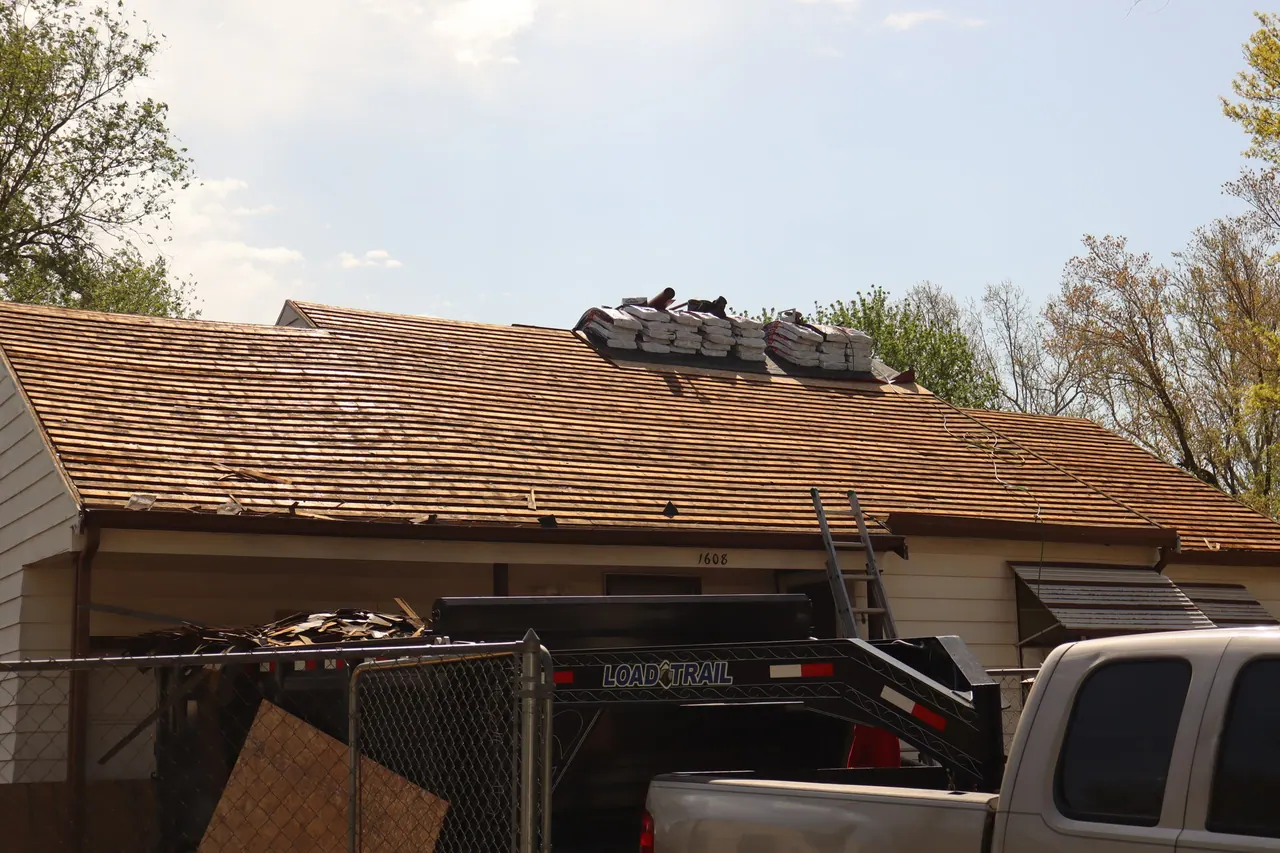
Dan tarps active leak spots on a wood shake roof while the homeowner’s insurance claim is underway, keeping interior damage from getting worse until the roof can be replaced.
What Does a Roof Soft Spot Mean on a Wichita Home? The honest answer depends on your roof’s age, material and the damage we can document. A free inspection from Wichita Roofing Pros gives you photos, a plain-English explanation and a written next step — with no obligation. Hablamos Español.
Schedule a Free Roof InspectionCall (316) 742-1900Frequently Asked Questions About Roof Soft Spots in Wichita KS
Is a roof soft spot covered by homeowner’s insurance in Wichita?
Coverage depends on the cause. If the decking damage resulted from a covered event—such as wind or hail from a storm—the resulting soft spot and associated repair may be covered. If the damage resulted from gradual moisture intrusion or deferred maintenance, most standard homeowner policies classify it as wear and tear or neglect, which is excluded from coverage. Documenting the soft spot professionally and identifying the cause clearly is important before filing any claim, since cause determination affects the coverage outcome.
How quickly can a small roof soft spot grow in Wichita conditions?
With an active leak source, a soft spot can expand meaningfully within a single rain season. OSB decking edges that are continuously wetted can delaminate across an entire panel within six to twelve months. In Wichita’s wet springs, homeowners who notice early soft spot indicators in April and delay repair until fall often find the damage has expanded to adjacent panels by the time a contractor arrives.
Can soft spots in roof decking affect the interior ceiling of a Wichita home?
Yes. Decking moisture eventually migrates through the insulation layer into drywall. This typically appears as ceiling staining, bubbling paint, or in advanced cases, sagging drywall sections directly below the compromised roof area. Interior ceiling damage is often the first visible sign homeowners notice, but it represents a later stage of a damage sequence that started at the decking level weeks or months earlier.
Do soft spots always require full decking replacement or can they be patched?
Small sections of surface delamination on an otherwise solid panel can sometimes be stabilized with injected adhesive and overlay material in temporary repairs, but replacement is the professional standard for any area where structural strength has been meaningfully reduced. Patching over compromised OSB or plywood does not restore its load-bearing properties and creates a stress concentration at the patch boundary that can fail under storm loading.
How do I find a qualified contractor to assess a roof soft spot in Wichita?
Look for contractors who offer an attic inspection as part of their soft spot assessment—not just a surface walk. A contractor who quotes a repair price based only on the surface area visible from the roof may miss framing damage that is only apparent from below. Request a written scope that itemizes decking panels, any framing work, underlayment, and shingle replacement separately so you can compare proposals accurately.
On Wichita roof checks, one practical pattern we look for is whether the damage lines up with the storm direction, roof slope, attic moisture, and nearby exterior conditions. That extra context helps separate a small surface issue from damage that can turn into leaks during the next heavy rain.
Can you find a leak that others missed?
We trace water from the stain back to the entry point, check the attic and photograph what we find.
Why is my ceiling stain not under the leak?
Water runs along decking, rafters and insulation before it drips, so the entry point is often several feet away from the stain.
Can a roof leak be repaired in winter?
Often, yes. Many repairs can be done on dry, mild days, and emergency tarping can protect the home until then.