
Quick answerRoof granules are the small mineral fragments embedded in the surface of asphalt shingles that provide UV protection, fire resistance, impact resistance, and aesthetic color. When hail dislodges those granules, the exposed asphalt beneath begins aging at an accelerated rate, directly reducing the functional lifespan of the shingle.
After a hailstorm rolls through Wichita, granule loss is one of the most significant—and most misunderstood—forms of damage your roof can sustain. Unlike a missing shingle or a visible crack, granule loss is easy to overlook until it has already shortened your roof’s lifespan by years. Understanding what granule loss means, how to identify it, and what to do next is essential for every Sedgwick County homeowner navigating the post-hail assessment process.
What Are Roof Granules and Why Do They Matter in Wichita?
Roof granules are the small mineral fragments embedded in the surface of asphalt shingles that provide UV protection, fire resistance, impact resistance, and aesthetic color. When hail dislodges those granules, the exposed asphalt beneath begins aging at an accelerated rate, directly reducing the functional lifespan of the shingle.
Worried about your roof?Wichita Roofing Pros will check it for free and explain what we find in plain words.Book a Free Inspection or call (316) 742-1900
Granules serve several critical functions simultaneously. They shield the underlying asphalt matrix from ultraviolet radiation, which is the primary cause of long-term shingle degradation—without that UV barrier, asphalt oxidizes, becomes brittle, and eventually cracks. They also contribute to the shingle’s Class A fire rating by creating a non-combustible surface layer, and they provide the rough texture that gives asphalt shingles their impact absorption capacity. In a climate like Wichita’s, where NWS Wichita tracks multiple significant hail events each year across Sedgwick County, granule loss is not a hypothetical risk—it is a routine consequence of living in one of the most active hail corridors in the United States.
The asphalt beneath the granules is not designed for direct sun exposure. Once granules are stripped away by hail, the exposed matrix can lose five to ten years of effective service life in just two to three Wichita summers. A shingle with 30% granule loss is not 70% functional—the exposed areas degrade faster than the protected areas, creating stress fractures that spread across the entire shingle field over time.
How Can Wichita Homeowners Identify Granule Loss After Hail?
The most visible sign of granule loss after a Wichita hailstorm is an accumulation of dark, gritty material in your gutters, downspout splash pads, and along the foundation perimeter of your home. Dark impact spots on shingles—areas where the granules have been knocked away to reveal the gray-black asphalt beneath—are also visible from the ground on most residential roof pitches.
Check your gutters within 24 hours of any hail event. A normal amount of granule shedding occurs over the life of a shingle and will produce a small amount of granules in gutters after any heavy rain. What you are looking for after a hail event is a dramatic increase—gutters that contain a thick layer of granules, or downspout exits surrounded by a significant granule deposit on the ground below. The volume of granule accumulation correlates roughly with the severity of shingle surface damage.
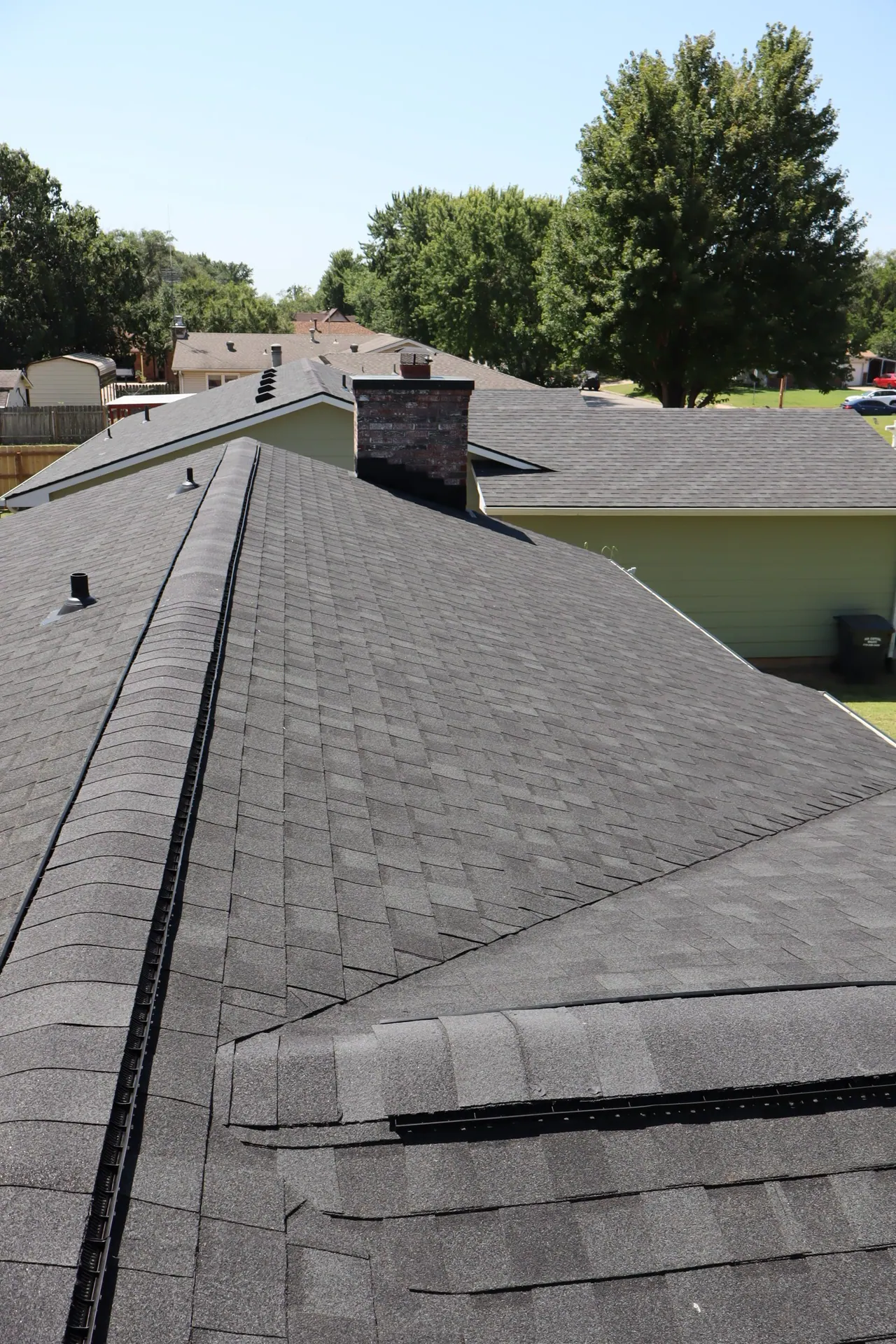
On the roof itself, look for shingles with irregular dark patches that appear matte or rough rather than uniformly textured. On a new or undamaged shingle, the entire surface should have a consistent granule coverage with no bare spots. Hail impact craters leave a roughly circular area of exposed asphalt surrounded by a small ring of displaced granules. If the hail was large enough to dent metal—check your gutters, downspouts, AC condenser fins, and metal vents for dents—the same energy was striking your shingles. A thorough hail damage roof inspection in Wichita is the only reliable way to quantify the full extent of granule loss across the entire roof plane.
On post-hail roof assessments in Wichita, the pattern we look for first is the distribution of impact marks across the shingle field—isolated random hits suggest a lighter event, while uniform coverage across all exposed roof planes indicates the kind of widespread granule displacement that typically warrants insurance documentation and a replacement conversation.
Roof granules are the small mineral fragments embedded in the surface of asphalt shingles that provide UV protection, fire resistance, impact resistance, and aesthetic color.
Does Granule Loss After Hail Qualify as Insurance Damage in Kansas?
Granule loss caused by hail is generally a covered loss under standard homeowner’s insurance policies in Kansas when the damage is documented as functional—meaning it materially reduces the shingle’s ability to perform its protective function—rather than merely cosmetic. The distinction between functional and cosmetic damage is the central battleground in most Wichita hail claims.
Kansas Insurance Department guidance and court precedent in the state have generally supported homeowner claims for hail-induced granule loss when a qualified inspector demonstrates that the granule displacement exposes the underlying asphalt to UV damage and reduces the shingle’s remaining service life. The key is documentation: a professional inspection report that includes photographs of each affected roof plane, granule measurements, and an assessment of remaining shingle life provides the evidentiary foundation for a functional damage claim.
Insurers in the Wichita market commonly deploy adjusters or third-party inspection firms to evaluate hail claims. Having your own independent roofing contractor present during the adjuster’s inspection is one of the most effective steps you can take to ensure all damage is captured. Your contractor can demonstrate granule displacement that a non-roofing professional might attribute to normal wear rather than storm impact. For the full claims process, consider scheduling a professional roof inspection in Wichita before your adjuster visit so you have an independent baseline.
How Does Granule Loss Affect Roof Lifespan and Performance?
Granule loss accelerates shingle degradation in direct proportion to the percentage of surface area that has been stripped, and even moderate hail-induced granule displacement can reduce a shingle’s effective service life by five to ten years, making early replacement more economical than deferred maintenance in many cases.
Consider a 15-year-old architectural shingle roof with an expected 25-year lifespan—it has roughly ten years of useful life remaining. After a significant hail event strips 25 to 40% of the granule coverage across the primary roof planes, that remaining lifespan compresses to five years or fewer as UV degradation accelerates on the exposed asphalt. When the replacement cost is amortized across the expected remaining life, a post-hail replacement often costs less per year of service than patching and waiting.
The ENERGY STAR program’s certified roof products include cool-roof shingle options that use specially coated granules to reflect more solar energy—an upgrade worth considering when a hail event triggers replacement on a Wichita home. Cool-roof granules maintain their reflective properties over the life of the shingle, reducing attic temperatures and cooling loads during Wichita’s hot summers. When evaluating replacement options after a hail event, ask your contractor about ENERGY STAR-rated products that also carry impact-resistance ratings appropriate for the Wichita hail environment.
What Should Wichita Homeowners Do Immediately After Noticing Granule Loss?
Immediately after noticing significant granule loss following a Wichita hail event, photograph the granule accumulation in gutters and on the ground, note the date of the storm, and contact a licensed local roofing contractor for a professional inspection before making any repairs or filing an insurance claim.
Sequence matters here. If you repair isolated areas before your insurer’s adjuster has seen the damage, you may inadvertently eliminate evidence needed to support a full-roof claim. Take photographs before touching anything—capture the granule accumulation in gutters, the dark impact spots on shingles visible from the ground, and any denting on metal surfaces (gutters, flashing, HVAC equipment) that corroborates the hail event’s severity. Cross-reference the storm date with NWS Wichita storm reports, which are publicly accessible and can confirm reported hail size and duration for your ZIP code.
After documenting the damage, call your insurer to open a claim and request a professional roofing inspection from a contractor you trust—ideally before the adjuster’s visit. Many Wichita homeowners find that an independent inspection report significantly strengthens their negotiating position if the adjuster’s initial assessment undervalues the damage. Our team provides detailed storm damage roof inspections in Wichita that include written reports suitable for insurance submission. You can also explore the broader range of repair and replacement options at our roof replacement page or contact us directly through our contact page.
Is granule loss in gutters always caused by hail?
No. Some granule shedding is normal throughout a shingle’s lifespan—new shingles shed loose granules in the first year, and aging shingles gradually shed over time. A significant increase in granule accumulation directly following a hail event, combined with visible impact marks on shingles, indicates storm-related granule loss rather than normal aging.
How much granule loss is considered significant in Wichita?
There is no industry-standard percentage threshold that universally triggers a claim, but insurance adjusters and roofing inspectors typically consider granule loss significant when impact marks are distributed across more than one roof plane and when the exposed asphalt is visible from normal inspection distance. Your contractor can provide a written assessment quantifying damage per roof section.
Can I replace only the shingles that lost granules after hail?
Technically yes, but spot replacement of hail-impacted shingles is rarely advisable on a hail event that affected the entire roof. If hail struck one side of the roof with enough force to strip granules, it typically affected all exposed planes. Replacing only the most visible sections leaves the rest of the aging, compromised shingle system in place and often fails to satisfy insurance replacement coverage requirements.
How long does it take for granule loss to cause a leak in Wichita?
Granule loss itself does not immediately cause leaks—it accelerates UV degradation that eventually leads to shingle cracking and water infiltration. Depending on the severity of loss and the age of the shingle, this process can take anywhere from two to seven years after a significant hail event. The risk window accelerates on older shingles and south- or west-facing roof planes with maximum sun exposure.
Does granule loss affect my roof’s fire rating?
Yes. Asphalt shingles earn their Class A fire rating in part because of the non-combustible granule surface layer. Significant granule loss can reduce effective fire resistance at affected areas, though this is rarely the primary concern for homeowners—the accelerated UV degradation and water infiltration risk are the more immediate consequences in the Wichita market.
What hail size causes granule loss in Wichita?
Hail as small as 3/4 inch in diameter can displace granules on aged or weathered shingles. On newer, impact-rated shingles, meaningful granule loss typically requires hail of 1 inch or larger. Wichita sees measurable hail (3/4 inch and above) in several storm events per year, making granule loss a recurring concern across Sedgwick County neighborhoods.
Granule loss after hail is one of those roof conditions that looks minor from the ground but carries serious long-term consequences if left unaddressed. The granule layer is not decorative—it is a functional component that determines how long your shingle system will protect your home against Wichita’s intense summer UV radiation and recurring hail seasons. Prompt inspection, careful documentation, and an honest conversation about repair versus replacement can save Wichita homeowners significant money and prevent the interior damage that follows once a compromised shingle system begins to fail. Contact Wichita Roofing Pros to schedule a post-hail granule loss assessment, or learn more about comprehensive hail damage roof repair options in Wichita, KS.
Why Wichita roofs leak where they do
Most leaks we find around Wichita start at transitions, not in the middle of a slope: pipe boots, chimney and wall flashing, valleys, skylights and roof edges. Wind-driven rain and freeze-thaw cycles push water into small gaps that stay dry in a gentle shower.
Leak warning signs inside and outside your home
Water travels before it shows up, so the stain is rarely right under the problem. Watch for these signs.
- Brown rings or bubbling paint on ceilings
- Damp or musty smell in the attic
- Daylight visible through attic boards
- Dark streaks on rafters or decking
- Cracked or lifted pipe boots
- Rusted or loose flashing at chimneys and walls
- Shingles that feel soft underfoot (reported by a pro)
- Peeling exterior paint near roof edges
Common leak sources and typical fixes
Every roof is different, but these are the patterns we see most often.
| Leak source | What it looks like | Typical fix |
|---|---|---|
| Pipe boot | Stain near a bathroom or kitchen vent | Replace the boot and reseal |
| Chimney or wall flashing | Stain on a wall or near the chimney | Reflash or counter-flash |
| Valley | Stain where two roof planes meet | Repair valley shingles or metal |
| Skylight | Drips around the frame | Reflash or replace the skylight curb |
| Worn field shingles | Multiple stains, granule loss | Section repair or replacement |
Leak repair mistakes that cost more later
- Caulking over a leak without finding the source
- Painting over a ceiling stain
- Ignoring a drip that only appears in heavy storms
- Replacing drywall before the roof is fixed
- Skipping an attic check for wet insulation
What affects the cost of a leak repair
Price depends on the source, roof access and pitch, the material, and whether decking or insulation got wet. A pipe-boot or flashing repair is very different from a repair that needs decking replaced. You get the scope and price in writing after the inspection.
From our work: Wood Shake Leak Tarping

Dan tarps active leak spots on a wood shake roof while the homeowner’s insurance claim is underway, keeping interior damage from getting worse until the roof can be replaced.
What Does Granule Loss Mean After Hail in Wichita? The honest answer depends on your roof’s age, material and the damage we can document. A free inspection from Wichita Roofing Pros gives you photos, a plain-English explanation and a written next step — with no obligation. Hablamos Español.
Schedule a Free Roof InspectionCall (316) 742-1900Frequently Asked Questions
Why is my ceiling stain not under the leak?
Water runs along decking, rafters and insulation before it drips, so the entry point is often several feet away from the stain.
Can a roof leak be repaired in winter?
Often, yes. Many repairs can be done on dry, mild days, and emergency tarping can protect the home until then.
Is a small leak an emergency?
Any active leak should be addressed quickly. Small leaks soak decking and insulation and can lead to mold.



