
Quick answerThermoplastic polyolefin, or TPO, is a single-ply membrane roofing system widely used on commercial flat and low-slope roofs across Wichita. TPO membranes are factory-manufactured sheets, typically 45 to 80 mil thick, heat-welded at seams to create a continuous waterproof surface.
The decision between TPO roof repair and commercial roof replacement is one of the highest-stakes financial choices a Wichita commercial property owner makes. Get it wrong in either direction and the cost consequences are significant: replace too early and you waste tens of thousands of dollars on a system that had years of useful life remaining; repair too late and you spend thousands patching a roof that needs full replacement, delaying the inevitable while accumulating interior damage. This guide provides the framework Wichita property owners and managers need to make this decision correctly based on objective condition data rather than a contractor’s sales preference.
What Is TPO Roofing and Why Is It Common on Wichita Commercial Buildings?
Thermoplastic polyolefin, or TPO, is a single-ply membrane roofing system widely used on commercial flat and low-slope roofs across Wichita. TPO membranes are factory-manufactured sheets, typically 45 to 80 mil thick, heat-welded at seams to create a continuous waterproof surface. The material became dominant in the Wichita commercial roofing market over the past two decades because it combines good puncture resistance, heat-weldable seams that are repairable in the field, strong reflectivity that reduces cooling loads, and a competitive installed cost compared to EPDM or built-up alternatives.
Worried about your roof?Wichita Roofing Pros will check it for free and explain what we find in plain words.Book a Free Inspection or call (316) 742-1900
TPO is now the most common new-installation membrane type on Wichita commercial buildings, found on everything from medical office buildings near the Wesley and Via Christi campuses to warehouse and light industrial properties throughout Sedgwick County. Its prevalence means that most Wichita commercial property owners will eventually face a TPO repair or replacement decision. The good news is that TPO’s heat-weld seam technology makes field repair more reliable than many other membrane types when performed by a qualified contractor. The Wichita Roofing Pros commercial team performs TPO seam repairs and full replacements on Sedgwick County commercial properties.
How Do You Assess Whether a TPO Roof Is Repairable or Past Its Service Life?
A reliable TPO repair-versus-replace assessment requires evaluation of several condition indicators, not just a visual walk of the surface. The key assessment factors are membrane age, seam integrity percentage, insulation saturation extent, number and distribution of active leak points, and the underlying deck condition. No single factor is determinative on its own; the decision emerges from the combined picture.
Membrane age is the starting point. TPO systems installed with quality materials and maintained properly in Wichita’s climate typically deliver 15 to 25 years of service life. A 10-year-old TPO roof with isolated seam issues is a strong repair candidate. A 22-year-old TPO roof with widespread seam separation, multiple active leaks, and compressed insulation is likely past the economic repair threshold. The break-even test is straightforward: if the cost of targeted repairs exceeds 30 to 40 percent of the cost of full replacement, and the roof has less than five years of realistically expected remaining service life, replacement is usually the better investment. Contact Wichita flat roof repair specialists to schedule a condition assessment that produces a documented repair-versus-replace analysis for your specific building.
TPO membranes are factory-manufactured sheets, typically 45 to 80 mil thick, heat-welded at seams to create a continuous waterproof surface.
What Types of TPO Damage Are Best Addressed by Targeted Repair?
Several specific types of TPO damage respond well to targeted repair and are not indicators of systemic membrane failure. Understanding which damage types fall into this category helps property owners avoid premature replacement decisions driven by isolated issues.
- Isolated seam separations — A seam that has partially separated at a lap can be cleaned and re-welded using the same heat-weld process used during original installation, producing a repair that is as strong as the original seam when done correctly.
- Penetration boot failures — Pipe boot seals at HVAC penetrations, vent stacks, and conduit entries are high-stress points that commonly fail before the main membrane. Replacing individual boots is a routine repair that does not indicate broader membrane problems.
- Puncture repairs — Mechanical punctures from dropped tools, HVAC work, or hail impact in thin areas can be patched with compatible TPO material. Hail damage assessment on TPO requires professional evaluation because functional hail damage is often not visible to the untrained eye.
- Drain collar reseals — The membrane-to-drain connection is a routine repair point on TPO roofs and does not indicate systemic failure when isolated to one or two drains.
- Parapet wall flashing repairs — Counterflashing and termination bar repairs at parapet walls address localized stress points without requiring membrane replacement.
Review the Wichita roof repair services page for a full overview of the repair scope available for TPO and other commercial membrane systems.
What Conditions Signal That TPO Replacement Is the Right Choice?
While targeted repair handles isolated failures effectively, certain conditions indicate that the TPO system as a whole has reached or exceeded its economic service life. These signals should prompt a replacement conversation rather than another round of repairs.
Widespread seam separation across multiple roof sections is the clearest replacement indicator. When seams are failing systematically rather than at isolated points, the membrane has experienced material degradation that patch repairs cannot reverse. Extensive insulation saturation is another strong indicator: when moisture scanning reveals that more than 25 percent of the roof area has saturated insulation, the removal and replacement of wet insulation during re-roofing is financially justified. If an aging TPO roof has required two or more repair visits per year for three consecutive years, the cumulative repair cost trend makes replacement cost-competitive on a lifecycle basis. The Wichita commercial roofing specialists can model the lifecycle cost comparison specific to your building’s square footage and current condition assessment.
How Does Hail Damage Affect the TPO Repair-Versus-Replace Decision in Wichita?
Hail damage introduces a specific complication to the TPO repair-versus-replace decision because functional hail damage to TPO membranes is not always visible from the surface. While significant hail can create obvious punctures or bruising visible during a walk inspection, lower-energy hail impacts can compromise membrane integrity without producing obvious surface damage. This is why Wichita commercial property owners should request a professional hail damage assessment by a contractor familiar with TPO membrane failure modes any time the area experiences hail of one inch or larger, as documented by the National Weather Service Wichita office.
When hail damage is widespread and an insurance claim is active, the repair-versus-replace decision is partially determined by the insurance adjuster’s assessment of the damage scope. A qualified Wichita commercial roofing contractor can assist with the documentation process, providing photographs, core samples, and written damage assessments that support an accurate insurance claim. In cases where insurance proceeds are available for documented hail damage, the economics often shift toward replacement, since the insurance payment reduces the net out-of-pocket cost of a full system upgrade to a level that makes long-term financial sense even on a roof that might otherwise have been a repair candidate.
What Should Property Owners Know About TPO Repair Quality and Contractor Selection?
The quality of a TPO repair depends almost entirely on the technician’s heat-welding skill and the compatibility of repair materials with the existing membrane. TPO heat-welding requires calibrated equipment and trained operators to achieve consistent seam fusion temperatures. An improperly welded repair seam fails faster than the original installation — sometimes within a single winter — and produces a leak point that is indistinguishable from the original failure until it has caused interior damage. This failure mode is why the cheapest TPO repair bid in Wichita is rarely the best value.
Property owners should ask potential repair contractors directly about their technician training for TPO heat-welding, the brand of membrane used in repairs, and whether repair materials are compatible with the existing membrane manufacturer. Mixing incompatible TPO formulations produces seams that test well immediately but fail prematurely. A contractor who cannot answer these questions specifically should not be performing TPO heat-weld repairs on your Wichita commercial building. The team at Wichita Roofing Pros uses compatible repair materials matched to the existing membrane type on every commercial TPO repair project.
How Does ENERGY STAR Certification Factor Into TPO Replacement Decisions in Wichita?
When TPO replacement is the right call, Wichita property owners have the opportunity to select a replacement membrane that meets current energy performance standards. New TPO systems that carry the ENERGY STAR label deliver verified solar reflectance and thermal emittance ratings that reduce cooling loads on Wichita buildings during the long, hot summer months. The ENERGY STAR roof products directory allows owners to verify which specific TPO products meet the program’s performance standards before making a purchasing decision.
The energy cost benefit of a highly reflective TPO replacement versus an aging, degraded membrane can meaningfully offset the capital cost of replacement over a five- to ten-year payback horizon. For Wichita commercial buildings with large flat roof areas and high cooling loads — retail, warehouse, and light manufacturing — this calculation deserves explicit modeling during the replacement planning phase. A roofing contractor who discusses energy performance alongside material cost and installation warranty is giving you a more complete picture of the true replacement investment.
Why commercial roofs need a maintenance plan here
Inspections in spring and fall, plus after major storms, catch open seams, clogged drains and punctures before they turn into interior leaks and business interruptions.
Commercial roof inspection checklist for Wichita property owners
Property managers can track these items between professional inspections.
- Water ponding more than 48 hours after rain
- Open or lifted seams
- Blisters, cracks or shrinkage in the membrane
- Clogged drains, scuppers or gutters
- Damage around HVAC curbs and penetrations
- Loose or damaged edge metal
- Interior ceiling tile stains
- Debris or foot traffic damage near equipment
How we inspect a commercial roof
A consistent process gives owners and managers a clear budget picture.
- Review history. Age, past repairs and leak locations.
- Walk the field and perimeter. Seams, edges, flashings and equipment.
- Check drainage. Drains, scuppers and ponding areas.
- Document. Photos and notes for each issue.
- Prioritize. Now, soon and monitor, with written pricing.
Commercial roof mistakes that shorten roof life
- Skipping post-storm inspections
- Letting drains clog
- Allowing unprotected foot traffic around equipment
- Patching over wet insulation
- Replacing a roof that a repair would have extended
What affects commercial roofing cost
Roof size, system type, insulation, number of penetrations, drainage changes, access and whether wet insulation must be removed. A maintenance plan spreads cost out and supports budgeting.
From our work: Commercial Membrane Roof
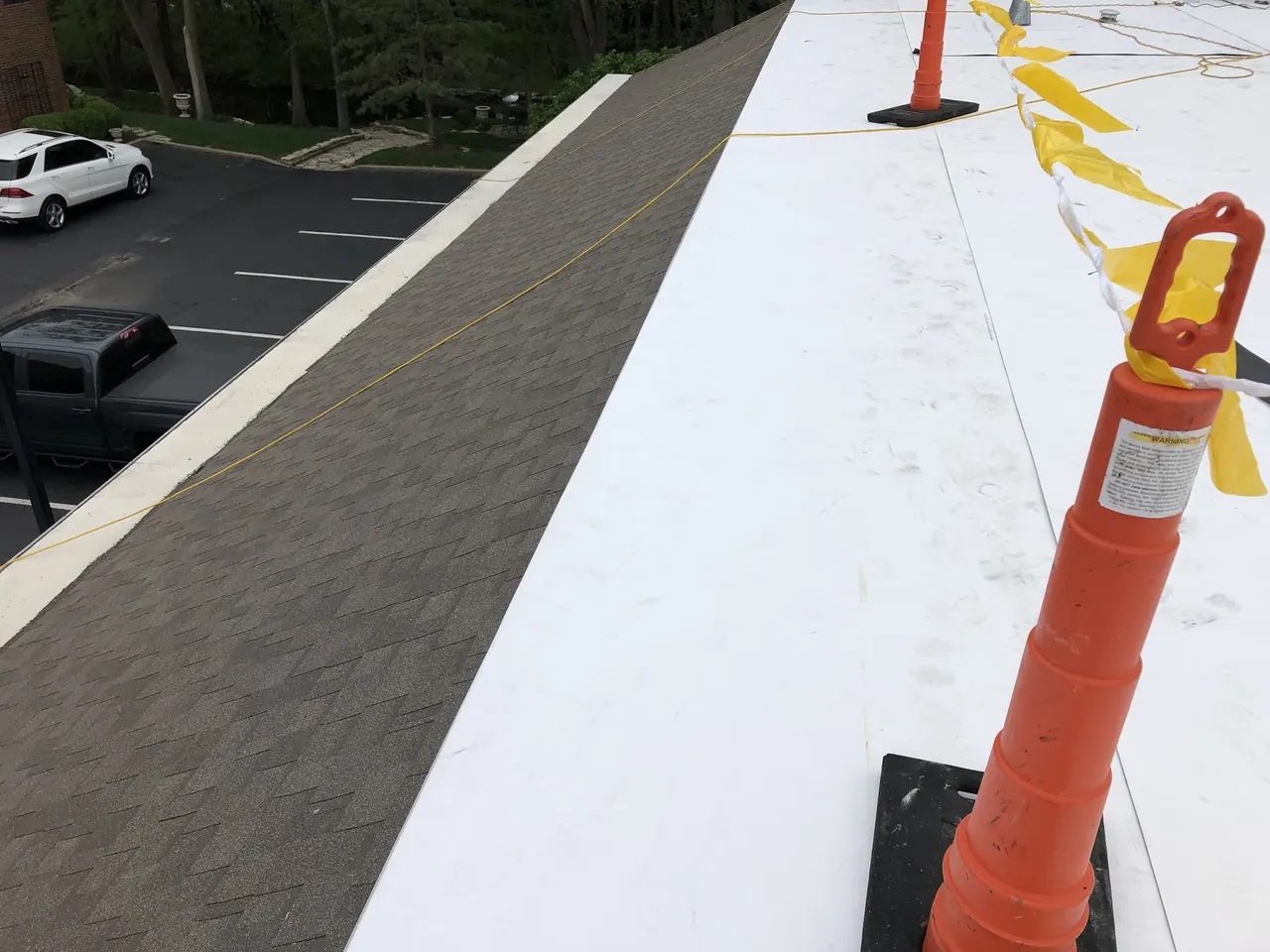
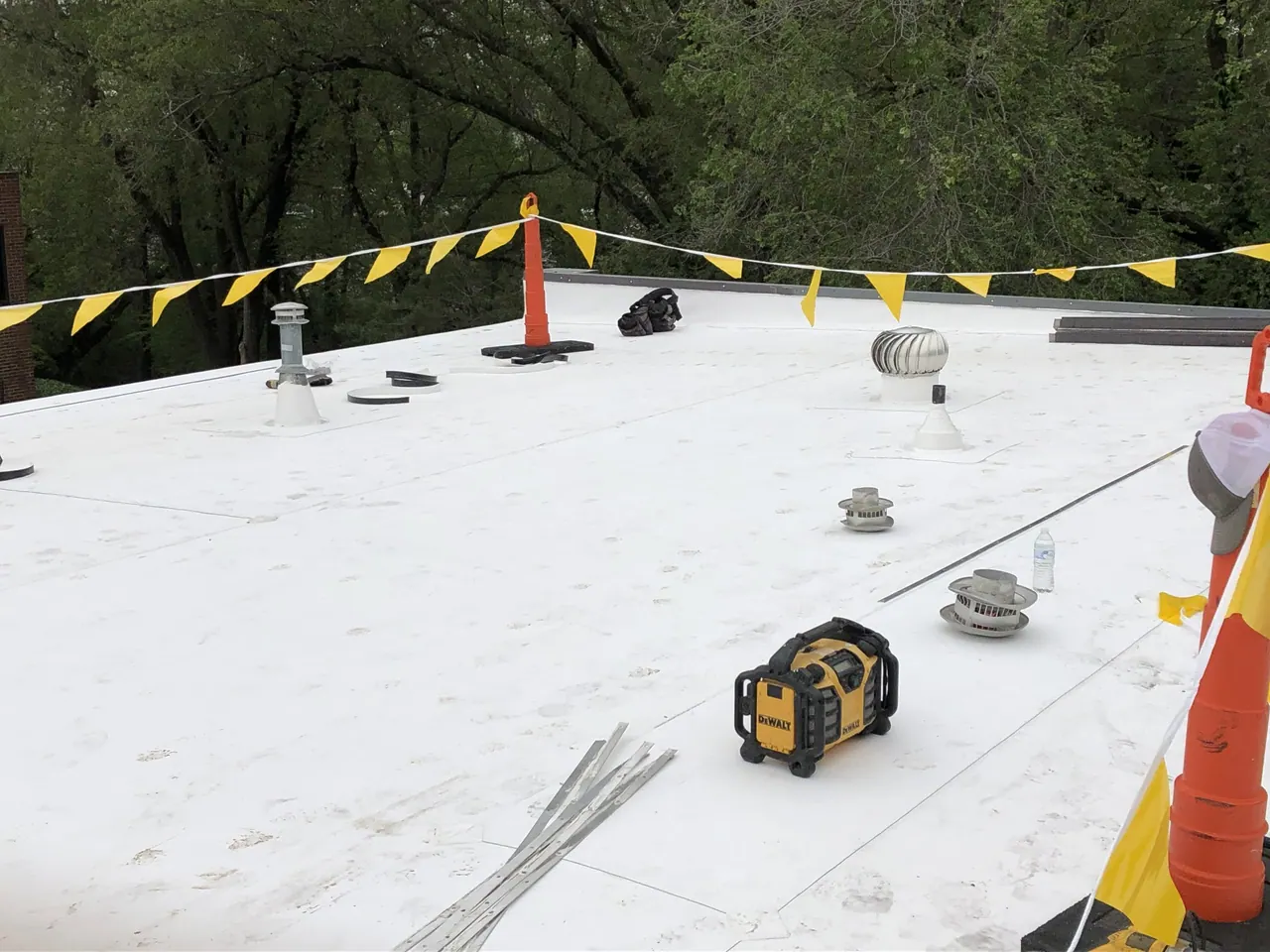
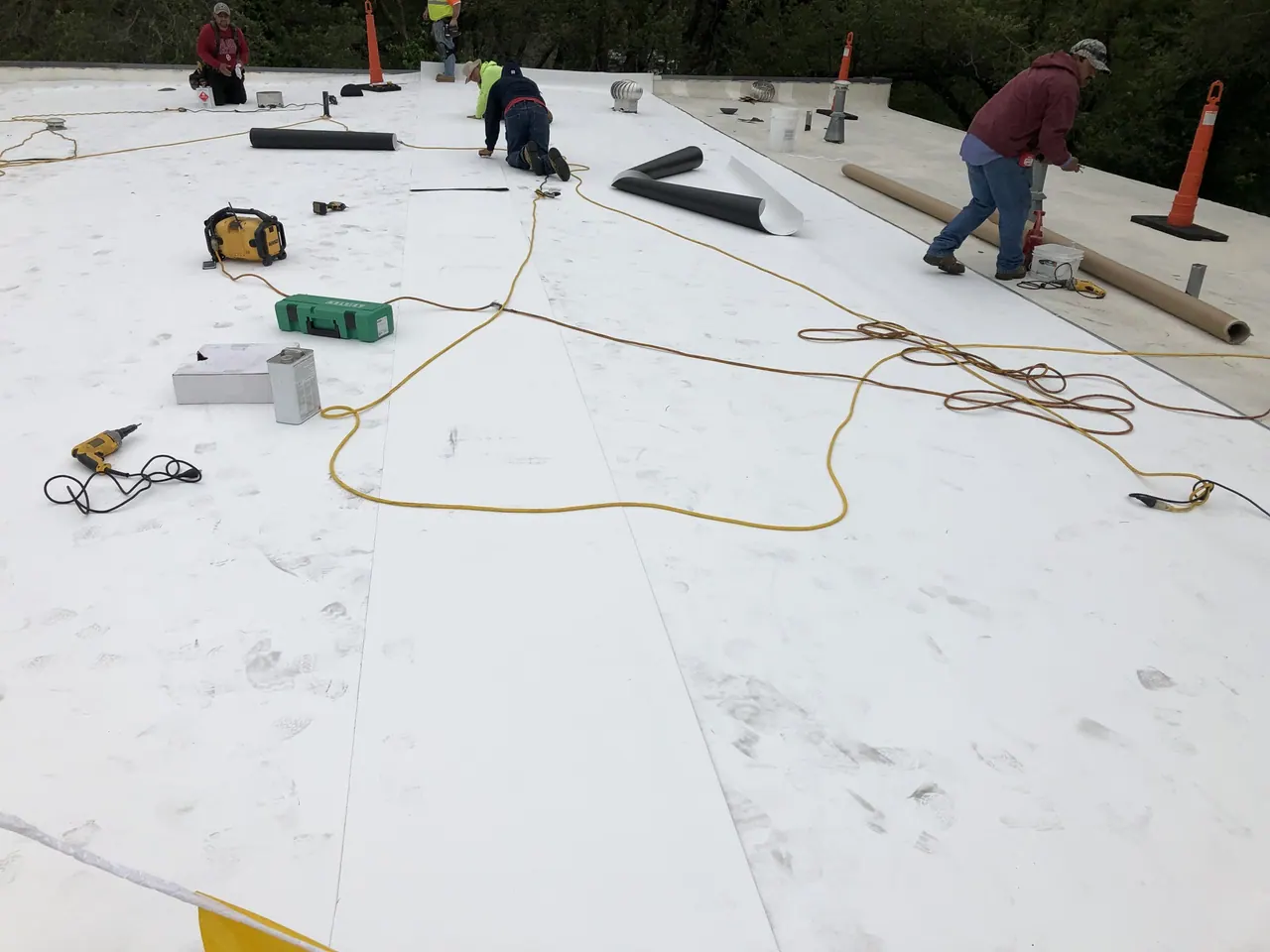
Insulation boards staged on the deck, then a white single-ply membrane rolled out, fastened and seamed across a low-slope commercial roof.
When Is TPO Repair Better Than Commercial Roof Replacement? The honest answer depends on your roof’s age, material and the damage we can document. A free inspection from Wichita Roofing Pros gives you photos, a plain-English explanation and a written next step — with no obligation. Hablamos Español.
Schedule a Free Roof InspectionCall (316) 742-1900Frequently Asked Questions About TPO Roof Repair in Wichita
What is the typical cost of TPO roof repair in Wichita, KS?
TPO roof repair costs in Wichita typically range from $300 to $900 for isolated seam repairs or single penetration boot replacements. More extensive repairs covering multiple seam failures, drain collar reseal, and parapet flashing work on a mid-size commercial roof generally run from $800 to $2,500. These ranges reflect Sedgwick County labor rates in 2026. Large-scope repairs or those involving insulation removal and replacement are priced as individual project estimates after a formal condition assessment.
How long does a TPO roof repair last in Wichita’s climate?
A properly executed TPO repair — using compatible materials and correctly calibrated heat-welding equipment — should last the remaining service life of the roof membrane when performed on a system that is not yet in systemic failure. Repairs on roofs still in the 10- to 15-year range with otherwise sound membrane have routinely held through multiple Wichita storm seasons. Repairs on roofs in the 18- to 22-year range may last two to five years before adjacent membrane degradation creates new failure points requiring additional repair.
Can a TPO roof be repaired in winter in Wichita?
TPO heat-weld repairs can be performed in cold weather with proper equipment and technique. Cold temperatures affect membrane flexibility and require adjusted welding parameters to achieve proper fusion. Emergency repairs in winter are viable for active leak control. Planned maintenance repairs, particularly those involving large membrane sections or complex flashing details, are better scheduled for spring or fall when ambient temperatures support optimal material performance. A Wichita commercial roofing contractor should advise you on timing based on the specific scope of your repair.
Does Wichita hail damage void a TPO roof warranty?
Hail damage does not automatically void a TPO membrane warranty. Most manufacturer warranties specifically address storm damage as a separate category from manufacturing or installation defect coverage. However, warranties typically require that storm damage be reported and documented within a specified timeframe and that the property owner has maintained the roof according to the warranty’s maintenance requirements. After a hail event in Wichita, contacting your roofing contractor promptly to document damage protects both your warranty status and your insurance claim rights.
Is TPO or EPDM better for Wichita commercial buildings?
Both TPO and EPDM are viable membrane choices for Wichita commercial flat roofs. TPO’s heat-weldable seams provide stronger lap connections than EPDM’s adhesive seams in field conditions. TPO also delivers higher solar reflectance, which reduces cooling loads during Wichita’s hot summers. EPDM has a longer proven track record and performs well in cold-weather flexibility tests. The best choice depends on the specific building application, existing deck type, budget, and whether energy performance or longevity is the primary priority. A Wichita commercial roofing contractor can recommend the appropriate system for your specific building.
Do you work with property managers?
Yes. We provide documented inspections and prioritized recommendations.
TPO or modified bitumen?
It depends on the building, foot traffic and budget. See our TPO vs. modified bitumen guide.
Do you offer commercial inspections in Wichita?
Yes. Call (316) 742-1900 to schedule.




