
Quick answerCommercial roof maintenance is a structured program, not a single visit. A complete maintenance program for a Wichita commercial property includes semi-annual inspections, drainage cleaning, seam and flashing assessments, penetration seal verification, and documented condition reporting after every visit.
Commercial roof maintenance in Wichita is not an optional line item. It is the single most effective way to extend the service life of a roofing system, control long-term repair costs, and protect the inventory, equipment, and employees inside the building. Yet many Wichita business owners treat their commercial roof as a set-and-forget installation, scheduling no professional attention until a visible leak forces the issue. By that point, what could have been a $400 maintenance visit often becomes a $15,000 repair or emergency replacement project. This guide outlines what every Wichita business owner should understand before their next commercial roof inspection cycle.
What Does Commercial Roof Maintenance Actually Include in Wichita?
Commercial roof maintenance is a structured program, not a single visit. A complete maintenance program for a Wichita commercial property includes semi-annual inspections, drainage cleaning, seam and flashing assessments, penetration seal verification, and documented condition reporting after every visit. The deliverable is not just the labor performed on the roof — it is the written record that establishes condition history, supports warranty claims, and provides evidence for insurance purposes after storm events.
Worried about your roof?Wichita Roofing Pros will check it for free and explain what we find in plain words.Book a Free Inspection or call (316) 742-1900
During a maintenance visit on a typical Wichita commercial building, a qualified roofing technician will clear drainage inlets, probe membrane seams for adhesion failure, inspect all roof penetrations including HVAC curbs and pipe boots, check parapet wall coping and cap flashing for movement, and evaluate any previously documented concern areas for progression. Findings are photographed and written into a condition report. This documentation is the asset that transforms a maintenance visit into long-term roof life extension. The commercial roofing team at Wichita Roofing Pros provides written condition reports with every maintenance visit for Sedgwick County properties.
How Does Wichita’s Climate Make Commercial Roof Maintenance More Critical?
Wichita’s south-central Kansas location subjects commercial roofs to a stress load that is above average for North American commercial properties. Hail events producing stones one inch in diameter or larger occur multiple times per decade across Sedgwick County. Straight-line wind events associated with spring and summer convective systems regularly exceed 60 mph, stressing membrane laps, flashing terminations, and HVAC equipment curb seals. The National Weather Service Wichita office documents storm paths across Sedgwick County, and the frequency of significant weather events in this region means commercial roofs experience more cumulative mechanical stress per year than properties in many other parts of the country.
Winter weather adds thermal cycling stress that compounds summer storm damage. A commercial roof in Wichita may experience 40 or more freeze-thaw cycles per winter season, each one expanding and contracting membrane materials, coping joints, and sealant at penetrations. This cycling is particularly hard on aging sealants at HVAC curbs, which are already under mechanical stress from equipment vibration. A maintenance program timed to inspect after freeze-thaw season in early spring and after storm season in late fall addresses the two periods when damage accumulates most rapidly.
This guide outlines what every Wichita business owner should understand before their next commercial roof inspection cycle.
What Are the Most Expensive Commercial Roof Problems That Maintenance Prevents?
The cost justification for commercial roof maintenance becomes clear when you map specific maintenance actions to the failures they prevent.
- Interior water damage — A $200 drain cleaning prevents the water intrusion event that damages ceiling tiles, electrical systems, and inventory. Interior damage claims routinely exceed $10,000.
- Membrane delamination — Catching a lifted lap seam during a semi-annual inspection allows a $150 reseal. Left unaddressed, delamination spreads across a full roofing section requiring $3,000 to $8,000 in membrane replacement.
- Insulation saturation — Insulation saturated with water loses R-value, increases structural load, and must be removed and replaced at significant cost. Probing penetration seals during maintenance catches the water entry points before saturation spreads.
- HVAC curb failures — HVAC equipment is the leading source of commercial roof leaks on Wichita buildings. Maintenance includes inspecting the membrane-to-curb connection after every storm season.
- Warranty voiding — Most commercial roof membrane warranties require documented maintenance. An owner who cannot produce maintenance records risks voiding warranty coverage on a $30,000 to $80,000 roofing system.
Understanding these failure chains makes the ROI calculation straightforward for any Wichita commercial property owner. Review the roof repair services page to understand the cost range for repairs that routine maintenance prevents.
How Should Business Owners Evaluate a Commercial Roofing Maintenance Contractor?
Not every contractor who offers commercial roof maintenance in Wichita is equipped to deliver a professional maintenance program. Business owners should evaluate candidates on several specific criteria before signing a maintenance agreement. First, confirm the contractor has direct experience with the specific membrane type on your building. TPO, EPDM, modified bitumen, and built-up roofing systems each have different maintenance requirements and failure modes. A contractor whose technicians primarily work with residential shingles is not the right fit for a TPO flat roof on a Wichita commercial building.
Second, ask to see a sample condition report from a previous maintenance visit. If the contractor cannot produce a written report with photographs, drainage status, seam condition notes, and a findings summary, their program does not deliver the documentation value that justifies the cost. Third, verify the contractor carries adequate commercial general liability and workers’ compensation coverage for work on commercial properties. The liability exposure on a commercial building is significantly higher than residential, and a contractor who is underinsured exposes the property owner to gap liability. The Wichita commercial roofing service area page outlines the types of properties and roof systems the team regularly maintains.
What Should a Commercial Roof Maintenance Schedule Look Like for Wichita Buildings?
A well-designed commercial roof maintenance schedule for a Wichita property accounts for the local weather cycle and the specific vulnerabilities of the roofing system. The baseline recommendation for most commercial flat roofs is a minimum of two professional inspections per year, with additional visits following any storm event that produces hail of one inch or larger, straight-line winds above 60 mph, or rainfall exceeding two inches in 24 hours. Wichita’s storm frequency makes this trigger-based inspection approach practical and financially sensible.
Spring inspection timing should target the window between the end of freeze-thaw season and the beginning of peak storm season — typically late March through mid-April in Wichita. This timing allows repairs identified during the inspection to be completed before the heaviest rain and hail months of May and June. Fall inspection timing should follow leaf drop and before the first freeze, typically October through early November, to clear drainage before winter and document any summer storm damage before warranty claim deadlines pass. A Wichita commercial roofing contractor can build a calendar-based program specific to your building’s history and current condition.
How Does Building Age Affect Commercial Roof Maintenance Requirements?
Maintenance requirements increase as commercial roofs age, and the investment in professional maintenance delivers higher returns on older systems. A TPO roof in its first five years needs primarily drainage maintenance and penetration checks. The same roof at year 12 needs all of that plus seam lap assessments, ponding water mapping, and parapet flashing condition scoring — because each of these components degrades at an accelerating rate in the 10- to 20-year window. Skipping maintenance on an aging roof does not reduce costs; it compresses the failure timeline and forces replacement earlier than the system’s full service life would warrant.
Wichita buildings in the older commercial districts — areas near the original downtown core, older industrial parks on the city’s west side, and mid-century retail corridors — commonly have roofing systems that are 15 to 25 years old. Many of these systems could be extended with targeted maintenance and spot repairs. The alternative to proactive maintenance on these roofs is a full replacement event that represents a capital expenditure many tenants and property owners prefer to defer. A qualified Wichita commercial roof specialist can assess whether maintenance extension is viable or whether replacement is the more economical path for a specific building.
What Role Does Energy Efficiency Play in Commercial Roof Maintenance?
Commercial roof maintenance intersects with energy efficiency in two important ways. First, maintaining a clean, intact reflective membrane surface preserves the roof’s designed solar reflectance. Dirty or degraded TPO and EPDM membranes absorb more heat, raising building cooling loads during Wichita’s hot summers. Second, catching and repairing insulation saturation early prevents R-value loss that increases HVAC runtime and energy cost year-round. The ENERGY STAR roof products program documents the energy performance benefits of reflective commercial roof systems — performance that maintenance programs protect over the full service life of the membrane.
Wichita commercial property owners managing buildings with significant cooling loads — large retail, warehouse, or light industrial spaces — have a direct financial incentive to keep reflective roofing systems in optimal condition. A maintenance program that keeps membrane surfaces clean and seams intact is not just a repair avoidance strategy; it is an ongoing operating cost management tool. Documenting reflectance condition during maintenance visits allows building managers to quantify degradation and schedule cleaning or recoating before cooling costs noticeably rise.
What Wichita weather does to low-slope roofs
Summer heat, UV, hail and heavy rain stress low-slope roofs differently than shingle roofs. Seams, flashings, drains and rooftop equipment curbs are the usual weak points, and ponding water speeds up wear.
Low-slope roof systems at a glance
Commercial systems are chosen separately from residential materials.
| System | Strengths | Often used for |
|---|---|---|
| TPO single-ply | Reflective white surface, heat-welded seams | Offices, retail, warehouses |
| Modified bitumen | Multi-ply toughness, puncture resistance | Roofs with foot traffic, smaller low-slope areas |
| Repair & maintenance | Extends roof life, lower upfront cost | Roofs with isolated issues |
How we inspect a commercial roof
A consistent process gives owners and managers a clear budget picture.
- Review history. Age, past repairs and leak locations.
- Walk the field and perimeter. Seams, edges, flashings and equipment.
- Check drainage. Drains, scuppers and ponding areas.
- Document. Photos and notes for each issue.
- Prioritize. Now, soon and monitor, with written pricing.
Commercial roof mistakes that shorten roof life
- Skipping post-storm inspections
- Letting drains clog
- Allowing unprotected foot traffic around equipment
- Patching over wet insulation
- Replacing a roof that a repair would have extended
What affects commercial roofing cost
Roof size, system type, insulation, number of penetrations, drainage changes, access and whether wet insulation must be removed. A maintenance plan spreads cost out and supports budgeting.
From our work: Commercial Membrane Roof
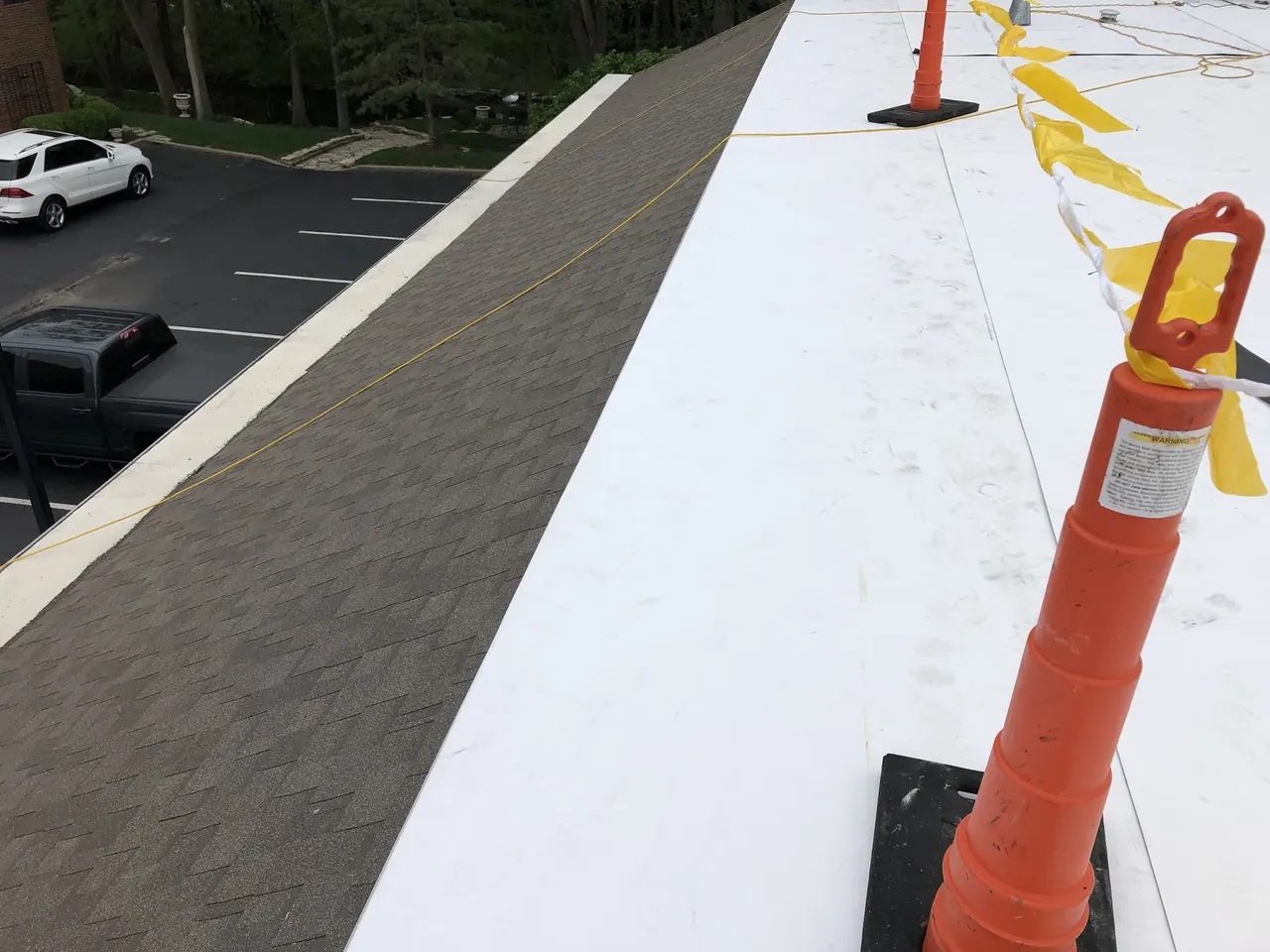
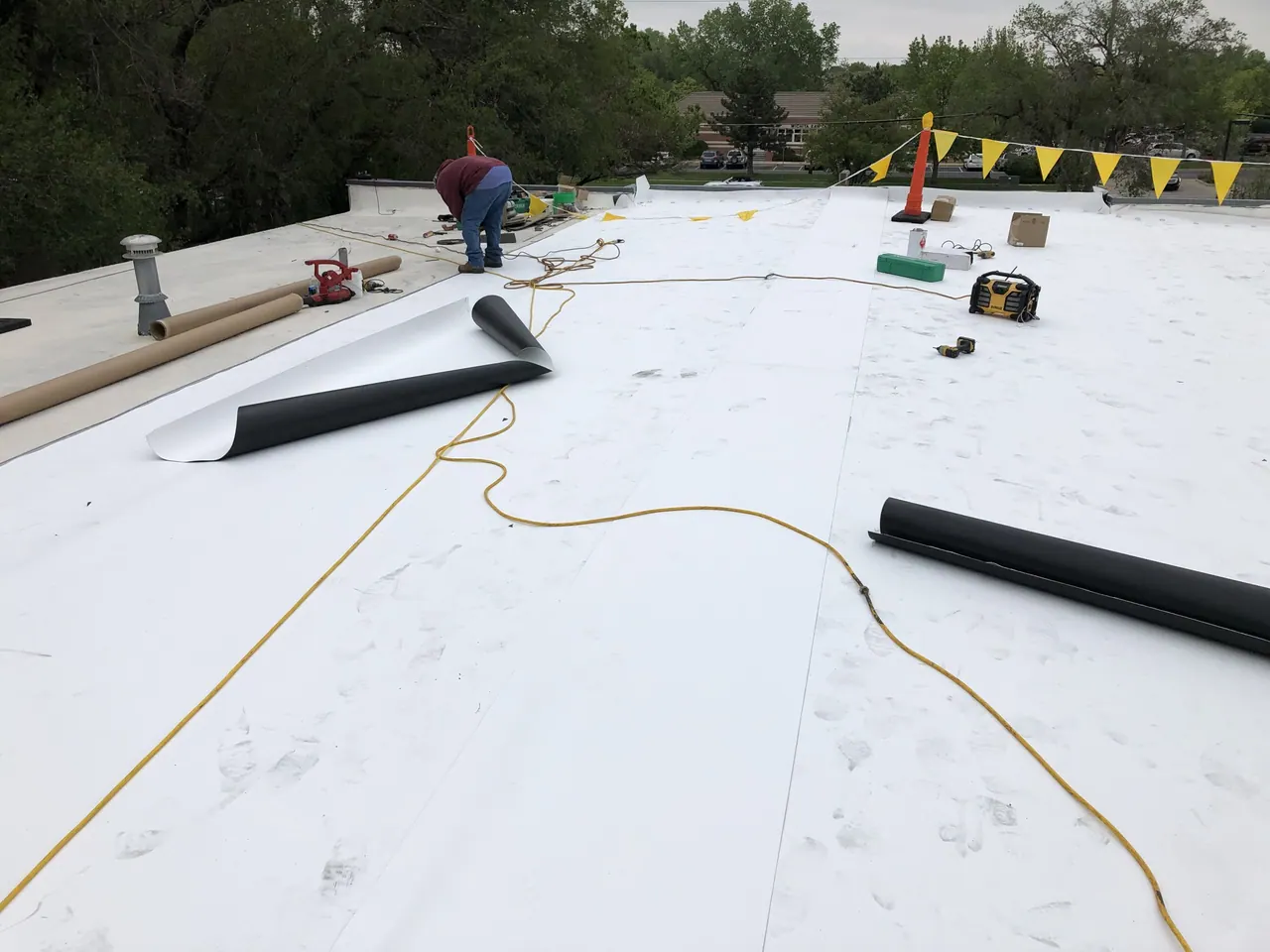
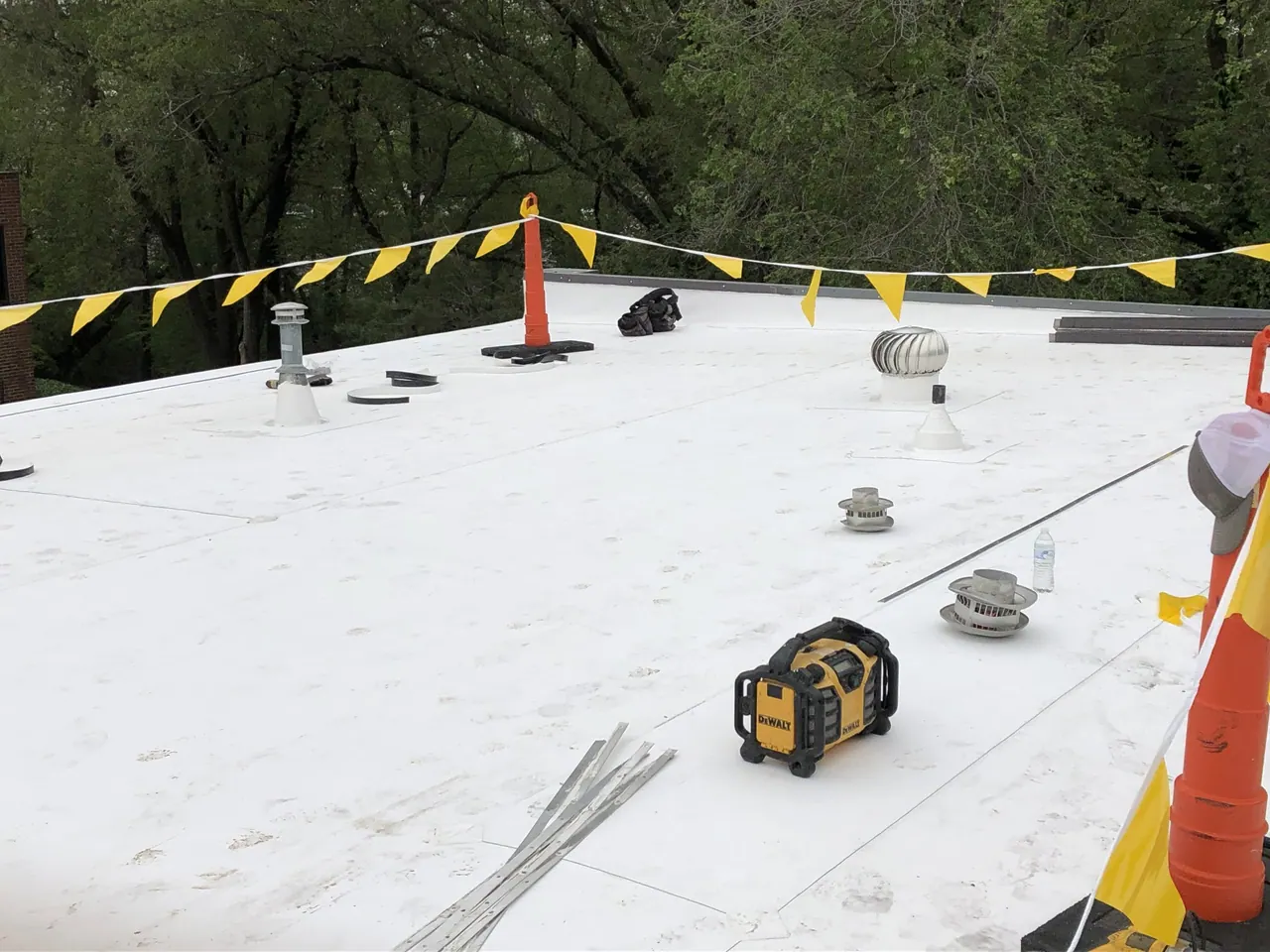
Insulation boards staged on the deck, then a white single-ply membrane rolled out, fastened and seamed across a low-slope commercial roof.
What Should Business Owners Know About Commercial Roof Maintenance in Wichita? The honest answer depends on your roof’s age, material and the damage we can document. A free inspection from Wichita Roofing Pros gives you photos, a plain-English explanation and a written next step — with no obligation. Hablamos Español.
Schedule a Free Roof InspectionCall (316) 742-1900Frequently Asked Questions About Commercial Roof Maintenance in Wichita
How much does a commercial roof maintenance program cost in Wichita, KS?
Commercial roof maintenance program pricing in Wichita depends on building size, roof type, and the number of annual visits included. Most small-to-medium commercial buildings under 10,000 square feet pay between $400 and $900 per visit for a professional maintenance inspection including written condition reporting and minor repairs such as drain cleaning and small sealant work. Annual programs covering two visits for a typical Wichita commercial flat roof generally run between $800 and $1,800, depending on complexity and location within Sedgwick County.
Does commercial roof maintenance affect a building’s insurance standing in Kansas?
Commercial property insurers in Kansas increasingly require evidence of maintained roofing systems when issuing or renewing policies on commercial buildings. A property owner who cannot document regular inspections and prompt repair of known issues faces risk of claim denial or policy non-renewal. After major hail events in Wichita, insurers have rejected claims on buildings with documented pre-existing maintenance neglect. Maintaining a written inspection history with dated photographs is the practical defense against this outcome.
What is the difference between a commercial roof inspection and a commercial roof maintenance visit?
A commercial roof inspection is an assessment-only activity: the contractor evaluates conditions and produces a report with findings and recommendations. A commercial roof maintenance visit combines assessment with hands-on corrective work, including drain cleaning, minor sealant repairs, fastener tightening, and lap reseal — work performed during the same visit that the inspection identifies. Maintenance programs that include both assessment and minor corrective work in a single visit deliver better value because they address findings immediately rather than scheduling a return trip.
How does the FORTIFIED commercial roofing program apply to Wichita buildings?
The FORTIFIED program, administered through the Insurance Institute for Business and Home Safety, includes commercial roof standards designed to improve wind and hail resistance. Wichita commercial properties that meet FORTIFIED standards may qualify for reduced insurance premiums because the designation indicates the roof assembly has been built or upgraded to documented performance levels. Maintenance plays a role in preserving FORTIFIED designation compliance over time. Visit fortifiedhome.org for current commercial program details and designation requirements.
When does commercial roof maintenance stop being cost-effective in Wichita?
Commercial roof maintenance loses its cost-effectiveness when the cumulative cost of annual maintenance and ongoing repair approaches or exceeds the amortized cost of full replacement. In practical terms, this threshold often arrives when a flat roof enters its 20th to 25th year and begins requiring multiple repair visits per year just to control active leaks. A qualified Wichita commercial roofing contractor can calculate a maintenance-versus-replacement break-even analysis for your specific building, giving you a data-based decision framework rather than an estimate driven by replacement sales pressure.
Can a TPO roof be repaired?
Yes. Seams and punctures can often be repaired when the rest of the membrane is sound.
Do you work with property managers?
Yes. We provide documented inspections and prioritized recommendations.
TPO or modified bitumen?
It depends on the building, foot traffic and budget. See our TPO vs. modified bitumen guide.




