Quick answerPonding water is defined in commercial roofing standards as water that remains on a roof surface 48 hours after the end of a rainfall event under conditions that allow evaporation. This definition draws a clear line between normal temporary water accumulation that drains within hours and the persistent standing water condition that indicates a drainage design or performance failure.
Ponding water on a Wichita commercial roof is not a cosmetic problem. It is a structural and waterproofing emergency in slow motion. Unlike a visible leak that prompts immediate repair calls, standing water sits quietly on a roof surface for days, weeks, or months before anyone inside the building notices the consequences. By the time ceiling stains appear or insulation is saturated, the damage has been accumulating for far longer than the property owner realizes. Understanding the causes of ponding water on Wichita commercial roofs is the starting point for preventing the progression from drainage problem to costly repair event.
What Is the Technical Definition of Ponding Water on a Commercial Roof?
Ponding water is defined in commercial roofing standards as water that remains on a roof surface 48 hours after the end of a rainfall event under conditions that allow evaporation. This definition draws a clear line between normal temporary water accumulation that drains within hours and the persistent standing water condition that indicates a drainage design or performance failure. On Wichita commercial flat roofs, ponding water most commonly appears as shallow pools in low areas of the roof — sometimes only a half-inch to two inches deep — that persist for days after a storm.
Worried about your roof?Wichita Roofing Pros will check it for free and explain what we find in plain words.Book a Free Inspection or call (316) 742-1900
The 48-hour standard matters for insurance and warranty purposes as well as for damage assessment. Many commercial roof membrane warranties specifically exclude damage caused by ponding water, defining it as a maintenance condition the property owner is responsible for correcting. A property owner who cannot demonstrate that their drainage system was maintained may face warranty claim denial for membrane damage in chronic ponding zones. The Wichita flat roof repair team evaluates ponding locations as part of every commercial roof assessment in Sedgwick County.
How Does Structural Deflection Create Ponding Zones on Wichita Buildings?
The most common and most overlooked cause of ponding water on Wichita commercial roofs is structural deflection — the gradual downward bending of roof deck framing and insulation layers under sustained load and thermal cycling. When a roof is first installed, the deck is designed to be level or slightly sloped toward drainage outlets. Over time, repeated loading from snow accumulation, HVAC equipment weight, and the weight of ponding water itself causes the deck framing to deflect between support points. This deflection creates low spots that were not in the original design, redirecting water away from drains toward these new collection areas.
Wichita’s expansive clay soils compound this problem by introducing movement at the foundation level that transfers upward through the building structure. Differential settlement between column footings causes roof framing elevations to shift relative to one another, creating slope reversals that direct water away from intended drainage paths. Buildings in older commercial districts where foundation soil behavior is well established are more likely to exhibit this type of long-term deflection-induced ponding than newer construction on sites with engineered fill. A thorough drainage assessment measures actual slope conditions across the roof surface, comparing them to the original drainage design, to identify where deflection has created new ponding risks. Contact Wichita Roofing Pros commercial roofing to schedule a slope and drainage assessment for your property.
Ponding water is defined in commercial roofing standards as water that remains on a roof surface 48 hours after the end of a rainfall event under conditions that allow evaporation.
What Role Does Insulation Compression Play in Ponding Water Development?
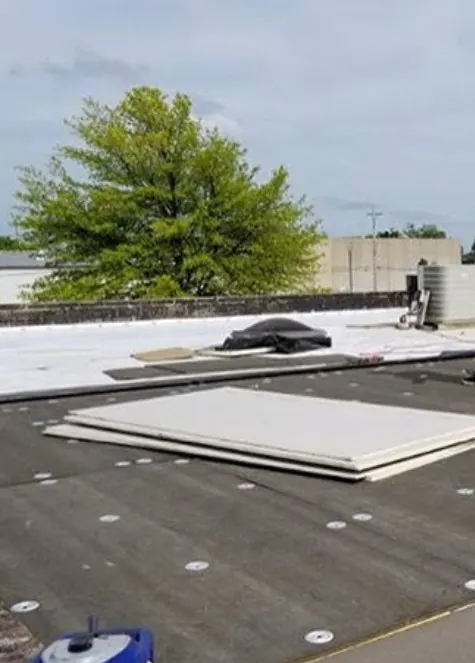
Beneath the membrane of most Wichita commercial flat roofs is a layer of rigid foam insulation, typically polyisocyanurate or expanded polystyrene, that provides the designed R-value and contributes to the roof surface slope through tapered installation. When this insulation compresses over years of foot traffic, equipment loading, and the cumulative weight of ponded water, the tapered slope flattens. Areas that once sloped adequately toward a drain begin to level out, reducing the drainage gradient below the minimum threshold for reliable water movement.
Insulation compression is a silent contributor to ponding because it is not visible from the roof surface. The membrane looks intact, the drains appear functional, but the underlying insulation has flattened in the heavily trafficked areas near HVAC equipment, rooftop walkways, and the drain basins themselves — precisely the areas where adequate slope is most critical. Probing the insulation during a maintenance inspection or performing a core cut to measure actual insulation thickness in suspect areas reveals whether compression has progressed to a level that is affecting drainage performance. The free roof inspection service from Wichita Roofing Pros includes documentation of suspected insulation compression zones.
How Do Blocked and Undersized Drains Contribute to Ponding on Wichita Roofs?
Drain blockage and undersizing are the most immediately correctable causes of ponding water, but they are also frequently overlooked until a ponding problem is already established. Wichita’s storm environment generates significant debris loading on commercial rooftops — cottonwood seeds in late spring, leaf fall in October and November, and granule shedding from aging modified bitumen sections all contribute to drain basin accumulation. A drain strainer that is not cleared regularly becomes a partial dam, slowing flow even when the main drain pipe below is unobstructed.
- Debris-blocked drain basins — The most common and most preventable cause; cleared by routine maintenance.
- Partial standpipe obstruction — Sediment and debris compacted in the standpipe below roof level reduces flow capacity; requires rodding or jetting to clear.
- Undersized drain for actual roof area — Building additions or modifications sometimes increase the roof drainage area served by an existing drain without upgrading the drain size, creating chronic overload during peak rainfall events.
- Drain elevation mismatch — If the drain rim elevation has shifted relative to the surrounding membrane due to settling, water must pond to a depth equal to the elevation differential before it begins flowing into the drain.
- Frozen drain outlets — In Wichita winter events, standing water in drain basins can freeze solid, blocking drainage entirely until the ice melts. This condition often reveals that warm-period ponding was already present before the freeze.
Review the roof repair services page for drainage correction options available to Wichita commercial property owners.
What Weather Conditions in Wichita Make Ponding Water Especially Damaging?
Wichita’s climate creates a particularly aggressive set of conditions for ponding water damage. The combination of intense short-duration rainfall in spring and summer, high UV exposure in the summer months, and freeze-thaw cycling in winter subjects ponding areas to three distinct damage mechanisms that do not operate in milder climates. The National Weather Service Wichita forecast office documents the frequency and intensity of rainfall events across Sedgwick County, and the data reflects a storm environment that regularly exceeds drainage system design parameters on buildings where maintenance has been deferred.
Spring storms producing one to two inches of rain in under an hour can create temporary ponding depths of four to six inches on a roof with even partially blocked drainage. At this depth, a 30-by-30-foot ponding zone carries approximately 14,000 pounds of water weight — load that the roof structure was not designed to sustain continuously. Summer UV radiation, reflected and magnified at the water-membrane interface, accelerates polymer breakdown in ponding zones two to three times faster than in dry roof areas. Winter freeze-thaw cycles then open the seams and membrane damage that summer UV initiated, allowing water infiltration that spreads invisibly through the insulation layer until spring thaw makes it visible as ceiling moisture.
How Does Ponding Water Void Commercial Roof Warranties on Wichita Buildings?
Most commercial roof membrane warranty documents address ponding water explicitly, either excluding coverage for damage caused by standing water or requiring the property owner to demonstrate that drainage maintenance was performed on a defined schedule. When ponding water damage is identified during a warranty claim, the manufacturer’s representative will typically assess whether the ponding condition was chronic versus isolated and whether maintenance records document that drainage components were maintained. A property owner without maintenance records faces an uphill warranty claim on ponding-related damage regardless of whether the underlying issue was a manufacturing defect or an installation problem.
Wichita commercial property owners who invest in documented maintenance programs gain two warranty protections: they preserve their claim rights if a genuine manufacturing or installation defect causes membrane failure in a non-ponding area, and they demonstrate due diligence that limits their exposure when a claim does involve drainage-related damage. A qualified Wichita commercial roofing contractor who provides written condition reports and maintenance records after every visit gives you the documentation foundation to defend warranty claims effectively.
What Structural Corrections Address Chronic Ponding on Wichita Commercial Roofs?
When ponding water results from structural deflection or insulation compression rather than blocked drainage, correction requires intervention at the roof system level rather than surface maintenance. The most common structural corrections for chronic Wichita commercial roof ponding are tapered insulation installation, drain reconfiguration, and addition of overflow scuppers. Tapered insulation involves installing additional insulation panels cut to a slope profile that re-establishes positive drainage toward existing or relocated drains. This approach can be applied over an existing membrane on a re-roofing project or during a targeted repair sequence without full membrane replacement.
Drain reconfiguration addresses cases where the original drain layout has been compromised by building modifications or structural movement. Adding a new drain in a persistent ponding location, or relocating an existing drain to align with where water actually collects, corrects the root cause rather than treating symptoms. Overflow scupper additions address the secondary hazard of catastrophic structural loading if primary drains are blocked during a major Wichita storm event. Buildings that lack code-compliant overflow drainage provisions may be required to add them when a re-roofing project triggers a building permit, making the replacement project an opportunity to bring the drainage system into full compliance. The Sedgwick County commercial roofing team has experience with drainage correction scopes across the range of building types common in greater Wichita, from mid-century warehouse construction to modern retail and medical office buildings. Wichita Roofing Pros documents every drainage correction with before-and-after slope measurements so property owners have verifiable evidence that the correction was effective.
Why commercial roofs need a maintenance plan here
Inspections in spring and fall, plus after major storms, catch open seams, clogged drains and punctures before they turn into interior leaks and business interruptions.
Commercial roof inspection checklist for Wichita property owners
Property managers can track these items between professional inspections.
- Water ponding more than 48 hours after rain
- Open or lifted seams
- Blisters, cracks or shrinkage in the membrane
- Clogged drains, scuppers or gutters
- Damage around HVAC curbs and penetrations
- Loose or damaged edge metal
- Interior ceiling tile stains
- Debris or foot traffic damage near equipment
How we inspect a commercial roof
A consistent process gives owners and managers a clear budget picture.
- Review history. Age, past repairs and leak locations.
- Walk the field and perimeter. Seams, edges, flashings and equipment.
- Check drainage. Drains, scuppers and ponding areas.
- Document. Photos and notes for each issue.
- Prioritize. Now, soon and monitor, with written pricing.
Commercial roof mistakes that shorten roof life
- Skipping post-storm inspections
- Letting drains clog
- Allowing unprotected foot traffic around equipment
- Patching over wet insulation
- Replacing a roof that a repair would have extended
What affects commercial roofing cost
Roof size, system type, insulation, number of penetrations, drainage changes, access and whether wet insulation must be removed. A maintenance plan spreads cost out and supports budgeting.
From our work: Commercial Membrane Roof
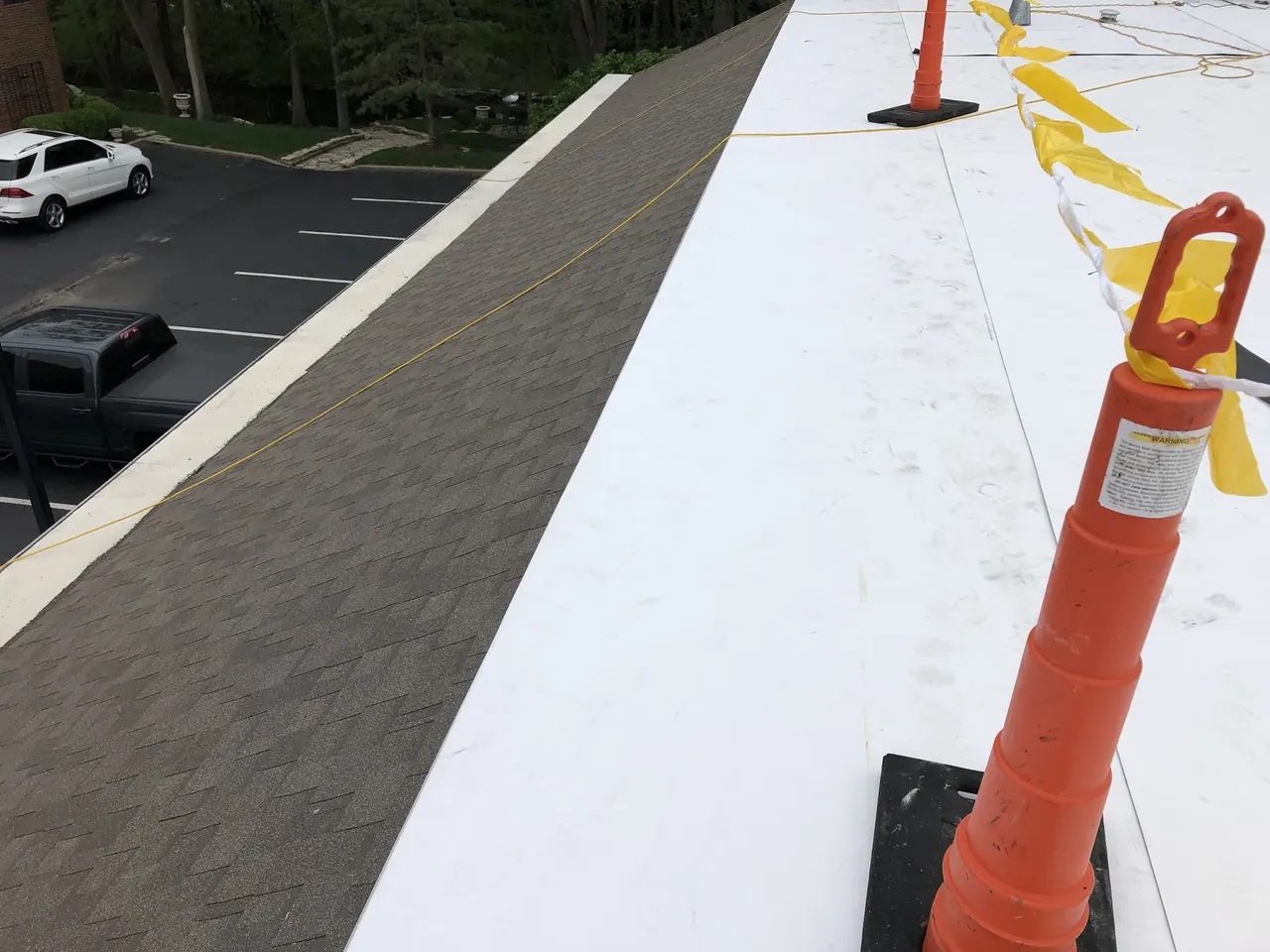
Insulation boards staged on the deck, then a white single-ply membrane rolled out, fastened and seamed across a low-slope commercial roof.
What Causes Ponding Water on Wichita Commercial Roofs? The honest answer depends on your roof’s age, material and the damage we can document. A free inspection from Wichita Roofing Pros gives you photos, a plain-English explanation and a written next step — with no obligation. Hablamos Español.
Schedule a Free Roof InspectionCall (316) 742-1900Frequently Asked Questions About Ponding Water on Wichita Commercial Roofs
How much water weight can a typical Wichita commercial flat roof support?
Most commercial flat roof structures in Wichita are designed to carry a live load of 20 pounds per square foot, which includes snow and temporary water loading. One inch of standing water over a roof surface weighs approximately 5.2 pounds per square foot. A sustained ponding depth of two to three inches approaches or exceeds the design load margin for some older structures, particularly those with longer span framing systems. Heavy ponding events combined with remaining snow load in late-winter events can approach structural limits more quickly than property owners expect.
Can ponding water on a Wichita commercial roof be repaired without full membrane replacement?
Yes, in many cases. If ponding is caused by blocked drainage or compressed insulation in isolated areas, targeted corrections — drain cleaning, insulation crickets, or tapered overlay panels — can resolve chronic ponding without a full membrane replacement. If ponding has already caused membrane damage, blistering, or seam separation in the affected zone, membrane repair or section replacement is needed in addition to the drainage correction. A professional condition assessment that identifies the root cause of each ponding area determines whether targeted correction or broader replacement is the appropriate response.
Does ENERGY STAR roofing help reduce ponding water problems on Wichita buildings?
ENERGY STAR certification addresses a roof membrane’s solar reflectance and thermal emittance, not its drainage design. A highly reflective membrane does not drain faster than a non-reflective one. However, because ponding water significantly degrades the reflective performance of any membrane over time, maintaining adequate drainage is essential to preserving the energy performance benefits that an ENERGY STAR membrane delivers. The ENERGY STAR roof products program provides performance specifications that help property owners select membranes with the best long-term energy and durability characteristics.
What FEMA resources are relevant to ponding water risk for Wichita commercial roofs?
FEMA provides structural design guidance for buildings in flood-prone areas, including roof drainage design requirements for properties in designated Special Flood Hazard Areas along the Arkansas River and its Wichita tributaries. Commercial property owners in or near FEMA flood zones should review applicable floodplain management requirements that may specify minimum roof drainage performance standards. Property managers can verify flood zone designation and review relevant technical guidance through the FEMA website and the City of Wichita Development Services floodplain management division.
How quickly should a Wichita property manager respond to a report of roof ponding?
A ponding water report should trigger a professional assessment within five to seven business days of the observation, assuming no active interior leaks are present. If interior ceiling staining or moisture is reported alongside the ponding observation, assessment should be scheduled within 24 to 48 hours because active water infiltration into the building assembly accelerates damage rapidly. After the assessment, any drainage corrections identified as urgent should be scheduled within 30 days to prevent the next storm event from adding to the existing damage. Documenting the discovery date and response timeline also protects the property owner if an insurance claim or warranty dispute arises later.
Do you offer commercial inspections in Wichita?
Yes. Call (316) 742-1900 to schedule.
How often should a commercial roof be inspected?
At least twice a year and after major storms.
Is ponding water a problem?
Water that stays more than about 48 hours speeds up wear and should be evaluated.