Quick answerGutters affect both foundation and roof health in Wichita by controlling where water goes the moment it leaves the roof surface. When gutters function correctly, they channel water to downspouts and direct it several feet away from the foundation perimeter, preventing soil saturation and basement water intrusion.
Gutters are easy to overlook until something goes wrong, but in Wichita and Sedgwick County the stakes are higher than in many parts of the country. The same storm systems that drop large hail on residential roofs also deliver several inches of rain in a short window, and gutters are the only mechanism standing between that volume of water and your foundation, siding, fascia, and roof edge. When gutters fail — through clogging, sagging, pulling away from the fascia, or simply being undersized for local rainfall intensity — the consequences work upward into roofing components and downward into foundation drainage simultaneously. Understanding that connection is the first step toward treating gutters as the roofing system component they actually are, rather than an afterthought that gets attention only after interior water damage appears.
How Do Gutters Affect Foundation and Roof Problems in Wichita?
Gutters affect both foundation and roof health in Wichita by controlling where water goes the moment it leaves the roof surface. When gutters function correctly, they channel water to downspouts and direct it several feet away from the foundation perimeter, preventing soil saturation and basement water intrusion. At the same time, properly pitched gutters prevent water from backing up under the drip edge, protecting the fascia board and the first course of shingles from prolonged moisture exposure. When gutters fail at either function, damage accumulates in two directions at once — downward into the foundation and upward into the roof structure — meaning a single deferred gutter repair can ultimately require both a foundation drainage correction and a partial roof replacement on the same property.
Worried about your roof?Wichita Roofing Pros will check it for free and explain what we find in plain words.Book a Free Inspection or call (316) 742-1900
What Foundation Damage Can Clogged Gutters Cause in Wichita?
Clogged gutters that overflow against the foundation wall are one of the most consistent causes of basement water intrusion and foundation soil erosion in Wichita-area homes. When gutters back up, water pours over the front edge and pools directly at the foundation perimeter, saturating the backfill soil placed against the foundation during original construction. That soil compresses and settles unevenly, which can cause hairline cracks in poured concrete or block foundations over time. In the clay-heavy soils common throughout Sedgwick County, the expansion and contraction cycle driven by repeated saturation and drying accelerates cracking at the foundation wall. Homes on flat lots or on lots that slope slightly toward the house are especially vulnerable because there is no natural grade to carry overflow water away from the structure before it reaches the foundation perimeter. Basement finishing projects in older Wichita neighborhoods frequently uncover staining and efflorescence at the base of foundation walls that trace directly to years of gutter overflow rather than groundwater issues.
When gutters function correctly, they channel water to downspouts and direct it several feet away from the foundation perimeter, preventing soil saturation and basement water intrusion.
How Do Failing Gutters Damage Roof Components Over Time?
Failing gutters damage the roof edge through several overlapping mechanisms that begin at the fascia board and work inward. A gutter that has pulled away from the fascia even a quarter inch allows wind-driven rain to reach the wood behind it, and fascia boards that remain wet for extended periods soften, rot, and eventually lose the structural integrity needed to hold gutter hardware securely under load. Once the fascia is compromised, water can wick into the rafter tails and the roof deck at the eave — the same zone where ice dam damage originates during Wichita’s winter cold snaps. Gutter weight from standing debris and pooled water accelerates the separation, pulling flashing away from the drip edge and creating an entry point for water that works its way under the first course of shingles. The National Weather Service in Wichita documents that the area receives roughly 30 inches of annual precipitation, with intense spring and summer convective events capable of delivering two or more inches per hour — a rate that overwhelms undersized or clogged gutters quickly and drives the moisture cycle that erodes fascia and drip edge over time.
What Are the Signs That Gutters Are Causing Roof Edge Problems?
Wichita homeowners should look for several specific signs that indicate gutters have already begun damaging the roof edge. Paint peeling or bubbling on the soffit and fascia directly below the gutter line is an early indicator of chronic moisture exposure from overflow. Rust staining or streaking on the exterior wall beneath gutter seams points to overflow at joints. Dark staining along the shingle surface at the eave, particularly near the corners of the roof, often indicates that water is backing up rather than running freely into the gutter channel. Inside the attic, soft or discolored decking at the eave perimeter confirms that water has already penetrated the roof assembly and begun acting on structural wood. During or immediately after heavy rain, walking the perimeter of the home and observing where water exits the gutter system — and where it spills over the front edge — is one of the most practical and cost-free diagnostic steps available. Our team provides a free roof inspection that includes assessment of gutter-to-roof-edge connections, drip edge condition, and fascia integrity at every attachment point.
How Should Wichita Homeowners Prioritize Gutter Repairs Alongside Roofing Work?
Wichita homeowners should treat gutter repairs as part of the roofing scope rather than a separate project to defer. Installing new shingles over a fascia that has been weakened by years of gutter overflow traps moisture and shortens the life of both the new shingles and the damaged wood beneath them. A correct repair sequence addresses fascia replacement or reinforcement first, installs new drip edge to direct water cleanly into the gutter channel, and then lays the new roofing material over the prepared eave. If existing gutters are inadequate in size or pitch, replacing them at the same time as a roof replacement is more cost-effective than returning later, because scaffolding, labor mobilization, and tarping are costs that apply to both scopes. Our residential roofing services coordinate these sequences so that each component of the drainage system works as part of a unified exterior envelope rather than a collection of independent trades.
What Role Do Downspout Extensions Play in Protecting Wichita Foundations?
Downspout extensions are one of the most cost-effective protective measures available to Wichita homeowners, yet they are frequently removed during landscaping projects or never installed on homes built before the 1990s. A standard downspout that terminates at grade level deposits water within twelve to eighteen inches of the foundation, which is insufficient separation on most Wichita residential lots. Extensions that carry water at least four to six feet from the foundation, or that connect to an underground drain tile system that daylight away from the structure, dramatically reduce soil saturation at the perimeter. FEMA’s guidance on residential flood mitigation consistently lists proper grading and drainage diversion as among the highest-value flood risk reduction strategies for existing homes. In neighborhoods near Chisholm Creek, the Little Arkansas River, or other Wichita drainage corridors, proper downspout termination combined with positive yard grading can be the difference between a dry basement and recurring water intrusion after moderate rain events that fall well short of flood stage.
How Can Wichita Homeowners Maintain Gutters Between Professional Inspections?
Routine gutter maintenance between professional inspections centers on keeping the channel clear and confirming that every section drains toward a downspout without standing water remaining after rain ends. Cleaning gutters at least twice per year — once after the spring storm season clears and once after fall leaf drop — removes the debris accumulation that causes overflow and holds moisture against the fascia board. While cleaning, check that gutter spikes or hidden hangers are tight and that no section has sagged away from its original pitch. Inspect end caps and seams for separation, since those are the most common overflow points when the channel itself is otherwise intact. For homes with significant tree canopy overhanging the roofline, installing gutter guards can extend the interval between cleanings, though guards require their own periodic inspection to confirm debris is not accumulating on top of the screen. See our roof and gutter repair services page for a full maintenance overview, and visit our Wichita service area page to learn more about the specific drainage conditions we encounter most often across Sedgwick County. Our team has worked throughout the Wichita metro long enough to recognize the debris patterns, moss accumulation, and gutter failure signatures specific to this climate, and we incorporate that field experience into every inspection and repair recommendation we provide.
Trees, wind and Kansas gutters
Mature trees in older Wichita neighborhoods fill gutters with leaves and seed pods every season, and strong wind can loosen hangers. Guards and properly spaced hangers cut down on clogs and sagging.
Signs your gutters need attention
Walk the house during or right after a rain and look for these.
- Water spilling over the front edge
- Sagging runs or pulled-away hangers
- Peeling paint or rot on fascia boards
- Stains or erosion under the gutter line
- Downspouts that dump next to the foundation
- Rust spots, cracks or leaking seams
- Granules from shingles collecting in the trough
- Plants growing in the gutter
How we evaluate a gutter system
Gutters, roof edges and fascia work together, so we look at all three.
- Check flow. Pitch, outlets and downspout placement.
- Inspect the edge. Drip edge, fascia and soffit condition.
- Look for overflow clues. Stains, erosion and splash marks.
- Size the system. Match capacity to roof area and pitch.
- Recommend. Repair, replace, add guards, or fix fascia first.
Gutter mistakes we see often
- Installing new gutters on rotted fascia
- Downspouts that end at the foundation
- Too few hangers for Kansas wind
- Skipping guards under heavy tree cover
- Replacing gutters right before a roof replacement without coordinating the drip edge
What drives gutter cost
Linear footage, number of stories, downspout count, gutter size, guards, and any fascia repair needed underneath. Coordinating gutters with a roof replacement can save a second trip. Pricing is provided in writing after the inspection.
From our work: Two-Tone Ranch Replacement
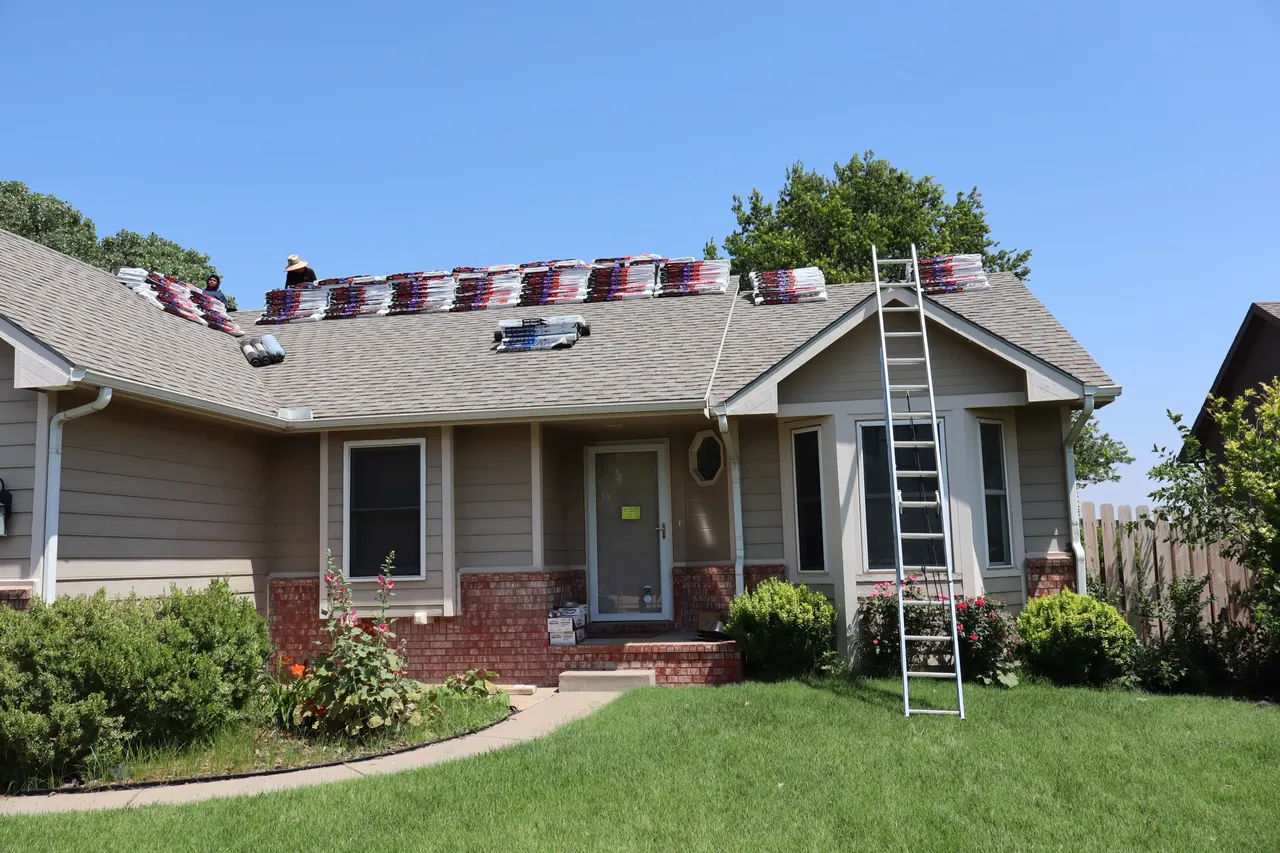
A brick and gray-siding ranch home during replacement: tear-off, crew setup, materials on site and the new architectural shingles going on.
How Do Gutters Affect Foundation and Roof Problems in Wichita? The honest answer depends on your roof’s age, material and the damage we can document. A free inspection from Wichita Roofing Pros gives you photos, a plain-English explanation and a written next step — with no obligation. Hablamos Español.
Schedule a Free Roof InspectionCall (316) 742-1900Frequently Asked Questions About Gutter Problems in Wichita
How often should gutters be cleaned in Wichita, KS?
Most Wichita homes benefit from gutter cleaning at least twice per year — spring and fall — with a third cleaning warranted for properties with heavy tree coverage over the roof. After any significant hail or wind event, a quick visual check is advisable because debris from damaged branches or dislodged shingles can block downspout inlets within hours of a storm passing through.
Can a foundation repair solve gutter overflow damage on its own?
Foundation repairs address structural symptoms but not the water source driving them. Without correcting the gutter overflow that saturated the soil, repaired cracks and sealed walls will face the same hydrostatic pressure again after the next heavy rain. The gutter system must be corrected simultaneously with any foundation remediation for the repair to hold over the long term.
Does homeowners insurance cover gutter-related roof damage in Wichita?
Insurance typically covers sudden storm damage to gutters and the roof edge, such as gutters torn away by wind or damaged by hail impact. Gradual damage from deferred maintenance — rotted fascia, eroded foundation soil, or deteriorated drip edge from chronic overflow — is generally excluded as a maintenance issue. Documenting gutter condition after each significant storm helps establish whether damage was sudden or incremental if a claim is later evaluated.
What is the difference between gutters pulling away and gutters sagging?
Gutters pulling away from the fascia means the fasteners have failed and the channel is separating from the board, which allows water behind the gutter to contact the fascia directly. Sagging refers to a section losing its pitch and holding standing water, which adds weight and stresses the hangers. Both conditions require repair, but pulling away is the more urgent issue because it is already exposing structural wood to direct, continuous moisture contact.
How do I know if my roof edge damage is from gutters or from the last hail storm?
Hail damage to the roof edge typically appears as spatter marks or bruising on shingles near the eave and dents in metal flashing or drip edge. Gutter-related damage, by contrast, presents as wood softening, paint peeling, or shingle granule loss concentrated along the eave line without corresponding impact marks on the main field of the roof. A professional inspection distinguishes the two causes clearly, which matters significantly when determining whether an insurance claim is appropriate for the observed damage and what scope of repair is warranted.
Are gutter guards worth it in Wichita?
For homes under trees, guards can significantly reduce clogs and overflow.
What are seamless gutters?
Gutters formed on site in continuous lengths, with joints only at corners and downspouts.
Why do my gutters overflow in heavy rain?
Common causes are clogs, poor pitch, too few downspouts or gutters that are too small for the roof.