
Quick answerFlat roofs are not truly flat. They are designed with a slight slope, typically one-quarter inch per foot, directing water toward internal drains, scuppers, or gutters.
Flat roof drainage problems are one of the most common and costly issues facing Wichita commercial and residential property owners. Unlike sloped roofs that shed water naturally, flat roofing systems depend entirely on engineered drainage design to move water off the surface. When that design fails, deteriorates, or gets overwhelmed by Wichita weather, standing water accumulates and the clock starts ticking on structural damage. Understanding how these problems begin is the first step toward preventing them on your building.
What Makes Flat Roof Drainage Different from Sloped Roofs?
Flat roofs are not truly flat. They are designed with a slight slope, typically one-quarter inch per foot, directing water toward internal drains, scuppers, or gutters. When this designed slope disappears due to settling, ponding, or blocked outlets, water has nowhere to go. Wichita’s heavy spring rain events and summer thunderstorms can deposit several inches of rain in a short window, overwhelming any drainage system that is not fully functional.
Worried about your roof?Wichita Roofing Pros will check it for free and explain what we find in plain words.Book a Free Inspection or call (316) 742-1900
Commercial buildings across Wichita, including warehouses near the I-135 corridor and older retail blocks in the downtown core, commonly use internal roof drains connected to vertical standpipes. Residential flat roofs and low-slope additions rely more heavily on perimeter gutters or scuppers. Both types share the same vulnerability: any obstruction or deformation in the drainage path leads to water accumulation. The flat roof repair specialists at Wichita Roofing Pros evaluate drainage slope and flow every time they inspect a low-slope property in Sedgwick County.
How Does Sedgwick County Weather Accelerate Flat Roof Drainage Failures?
Wichita’s climate creates conditions that specifically stress flat roof drainage systems. The city averages approximately 32 inches of rainfall annually, with May and June being the heaviest precipitation months. Spring storm systems frequently produce intense short-duration rainfall, sometimes exceeding one inch per hour. These high-intensity events can outpace drainage capacity even on well-maintained systems. The National Weather Service Wichita forecast office regularly issues flash flood watches across Sedgwick County during peak spring storm season, a direct indicator of how quickly water accumulates on flat surfaces in this region.
Winter freeze-thaw cycles compound the problem. When water is trapped in low areas of a flat roof and temperatures drop below freezing, ice forms and expands. This expansion works against seams, membrane laps, and drain collars. As temperatures rise, meltwater enters gaps opened by the ice, and the cycle repeats. Over several winters, this process degrades membrane integrity around drains and along parapet walls faster than anywhere else on the roof surface.
Understanding how these problems begin is the first step toward preventing them on your building.
What Are the Most Common Starting Points for Flat Roof Drainage Problems?
Flat roof drainage failures almost always begin at one of a small number of predictable locations. Identifying these locations early allows property owners to prioritize inspections and maintenance before ponding water becomes a structural issue.
- Clogged internal roof drains — Leaf debris, dirt, cottonwood seeds, and granules from aging membrane accumulate in drain basins. Drain strainers catch debris but must be cleaned regularly to remain effective.
- Blocked scuppers — Scuppers cut through parapet walls can become blocked by nesting material, debris accumulation, or sagging membrane that curls into the opening.
- Low spots from structural settling — Wichita’s expansive clay soils cause buildings to shift over time. Roof deck deflection creates low areas that were not in the original drainage plan, creating new ponding zones.
- Failed drain collar seals — The membrane-to-drain connection is one of the most stress-prone points on any flat roof. Thermal cycling and traffic cause the seal to crack or separate, creating both a leak point and a drainage obstruction.
- Parapet wall cap deterioration — Water entering through deteriorated cap flashing on parapet walls travels down the interior face and pools at the base, adding hidden moisture load to the roof assembly.
A thorough Wichita roof inspection maps every drainage component against current conditions and documents problem zones before they lead to interior damage.
How Does Ponding Water Damage a Flat Roof Over Time?
Ponding water is defined as water that remains on a roof surface 48 hours after rainfall ends. Even a shallow pool of one to two inches exerts meaningful weight and creates sustained chemical exposure against the membrane. At 5.2 pounds per gallon, a 10-by-10-foot area with two inches of standing water adds more than 500 pounds of unplanned load to the roof deck. Repeated over multiple storm seasons, this load contributes to deck deflection that worsens the drainage problem in a self-reinforcing cycle.
Membrane degradation from ponding is also a chemical process. UV radiation, accelerated by the reflective surface of standing water, breaks down membrane polymers faster in wet areas than dry ones. Algae and organic growth establish in persistently wet zones and produce acids that attack adhesive layers and lap seams. EPDM and modified bitumen membranes are particularly susceptible to organic growth colonization in the high-humidity conditions typical of Wichita summers. The commercial roofing team at Wichita Roofing Pros documents ponding locations with measurements and photographs during every assessment to track whether conditions are worsening between visits.
When Does a Drainage Problem Require Professional Repair Versus Routine Maintenance?
Not every drainage issue requires structural intervention. Property owners can handle routine drain cleaning and basic debris removal as part of a seasonal maintenance program. Professional repair becomes necessary when the cause of poor drainage is structural — deflected decking, settled roof substrate, failed drain collar, or blocked internal standpipe below the roof level. These conditions cannot be corrected by surface-level maintenance and will worsen without targeted repair work.
Signs that a drainage problem has moved beyond routine maintenance include: visible membrane cracking or blistering around drain basins, interior ceiling stains that appear or worsen after rain, visible sagging of the roof deck visible from inside the building, and water that still stands 72 or more hours after a dry period. Any of these signs warrant a professional evaluation by a Wichita flat roofing contractor familiar with both the drainage system design and the local weather load profile. Contact Wichita flat roof repair to schedule a drainage assessment specific to your building type and current conditions.
What Proactive Steps Reduce Flat Roof Drainage Risk in Wichita?
Property owners who establish a consistent maintenance routine experience significantly fewer emergency drainage failures. A twice-annual inspection cycle — one in early spring before storm season and one in late fall after leaf drop — keeps drainage components clear and identifies developing problems while repair costs are still modest. Sedgwick County property managers overseeing multiple buildings benefit from staggering these inspections across their portfolio rather than scheduling all buildings in the same week.
Specific proactive steps that deliver measurable results include: removing drain strainers and clearing basins of debris before May; verifying that all scupper outlets have clear drop zones at ground level; probing membrane seams around drain collars annually; documenting standing water areas with dated photographs after every significant rain event; and reviewing the original roof drainage plan against current conditions every five years to account for any structural changes. A commercial roofing professional familiar with Wichita’s specific storm profile can develop a customized maintenance schedule based on your building’s age, membrane type, and drainage system configuration. Review the Wichita roofing service area to confirm coverage for your property location.
How Are Flat Roof Drainage Problems Diagnosed on Wichita Commercial Buildings?
Professional drainage diagnosis goes beyond a visual inspection of the roof surface. An experienced Wichita flat roofing contractor assesses the complete drainage system from outlet to discharge point. This includes testing internal drains for flow rate, inspecting standpipes for obstructions, measuring the actual slope of the roof deck with a level, and comparing observed ponding locations against the original drainage design. Infrared moisture scanning adds another layer of information by revealing trapped moisture within the roof assembly that is not yet visible at the surface.
Wichita Roofing Pros has provided roofing services across Sedgwick County for years, working on building types from historic downtown commercial properties to modern industrial facilities near Eisenhower National Airport. That local project experience informs how drainage assessments are conducted — accounting for the specific soil movement patterns, storm load profiles, and building construction styles common to this region. A drainage diagnosis report from a local specialist gives you actionable data rather than generic recommendations copied from a national maintenance template.
What Should Building Owners Know About Flat Roof Drainage Codes in Kansas?
Kansas building codes, adopted and enforced at the local level by the City of Wichita Development Services division, require that roof drainage systems be designed to handle the local rainfall intensity for the building’s drain area. The International Building Code chapters governing roof drainage specify minimum drain sizing, overflow requirements, and scupper dimensions based on calculated rainfall rates. Overflow drains or secondary scuppers are required at a height above the primary drainage system to prevent catastrophic structural loading if primary drains become blocked.
Older Wichita buildings constructed before current code revisions may lack compliant overflow provisions. When drainage repairs or re-roofing work triggers a permit, the updated drainage plan must meet current code, which sometimes requires adding overflow scuppers or secondary drains that were not part of the original construction. A roofing contractor familiar with Sedgwick County roofing code requirements can identify these compliance gaps during the estimation phase rather than discovering them mid-project.
What Wichita weather does to low-slope roofs
Summer heat, UV, hail and heavy rain stress low-slope roofs differently than shingle roofs. Seams, flashings, drains and rooftop equipment curbs are the usual weak points, and ponding water speeds up wear.
Commercial roof inspection checklist for Wichita property owners
Property managers can track these items between professional inspections.
- Water ponding more than 48 hours after rain
- Open or lifted seams
- Blisters, cracks or shrinkage in the membrane
- Clogged drains, scuppers or gutters
- Damage around HVAC curbs and penetrations
- Loose or damaged edge metal
- Interior ceiling tile stains
- Debris or foot traffic damage near equipment
Low-slope roof systems at a glance
Commercial systems are chosen separately from residential materials.
| System | Strengths | Often used for |
|---|---|---|
| TPO single-ply | Reflective white surface, heat-welded seams | Offices, retail, warehouses |
| Modified bitumen | Multi-ply toughness, puncture resistance | Roofs with foot traffic, smaller low-slope areas |
| Repair & maintenance | Extends roof life, lower upfront cost | Roofs with isolated issues |
Commercial roof mistakes that shorten roof life
- Skipping post-storm inspections
- Letting drains clog
- Allowing unprotected foot traffic around equipment
- Patching over wet insulation
- Replacing a roof that a repair would have extended
What affects commercial roofing cost
Roof size, system type, insulation, number of penetrations, drainage changes, access and whether wet insulation must be removed. A maintenance plan spreads cost out and supports budgeting.
From our work: Commercial Membrane Roof
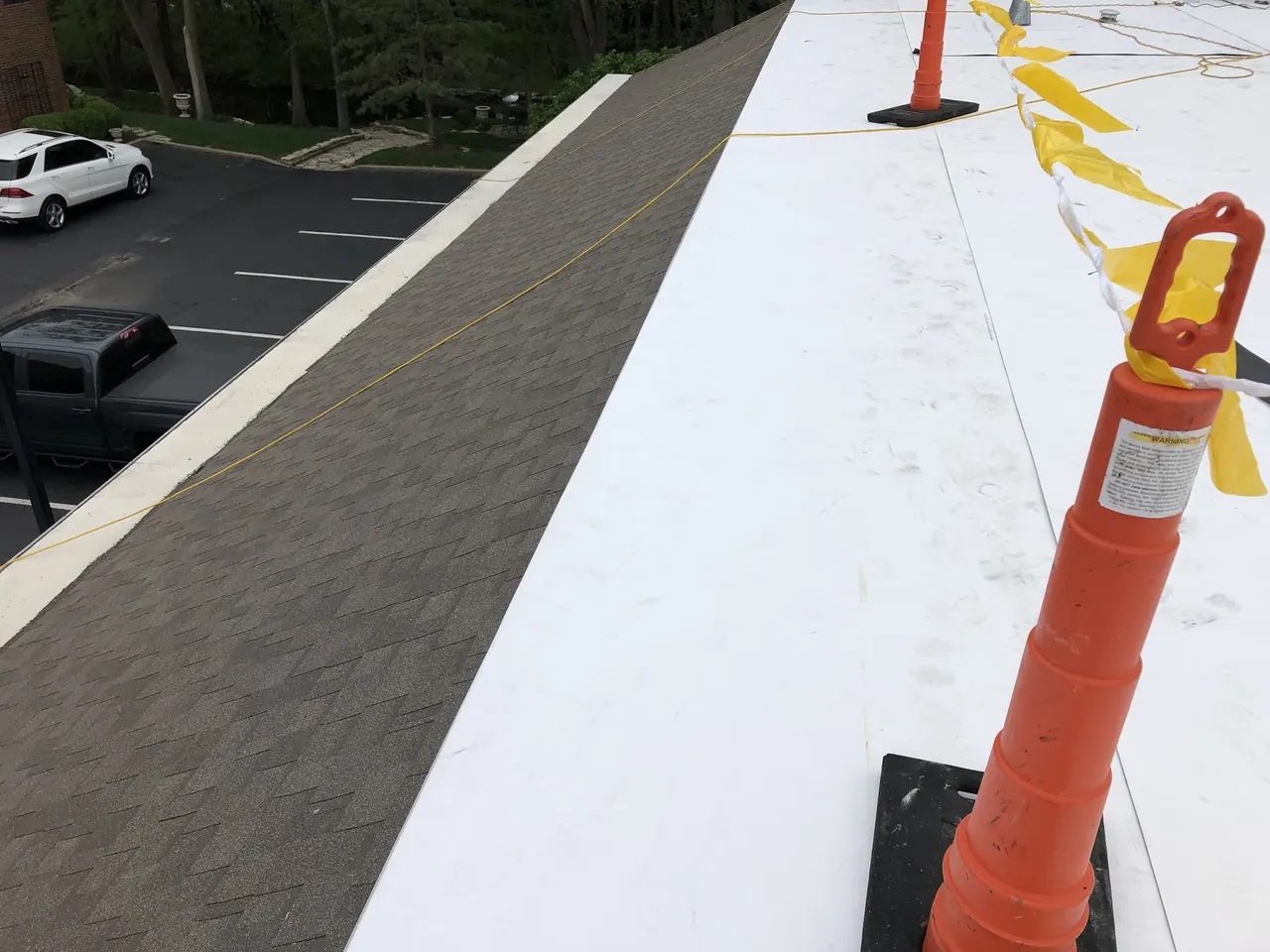
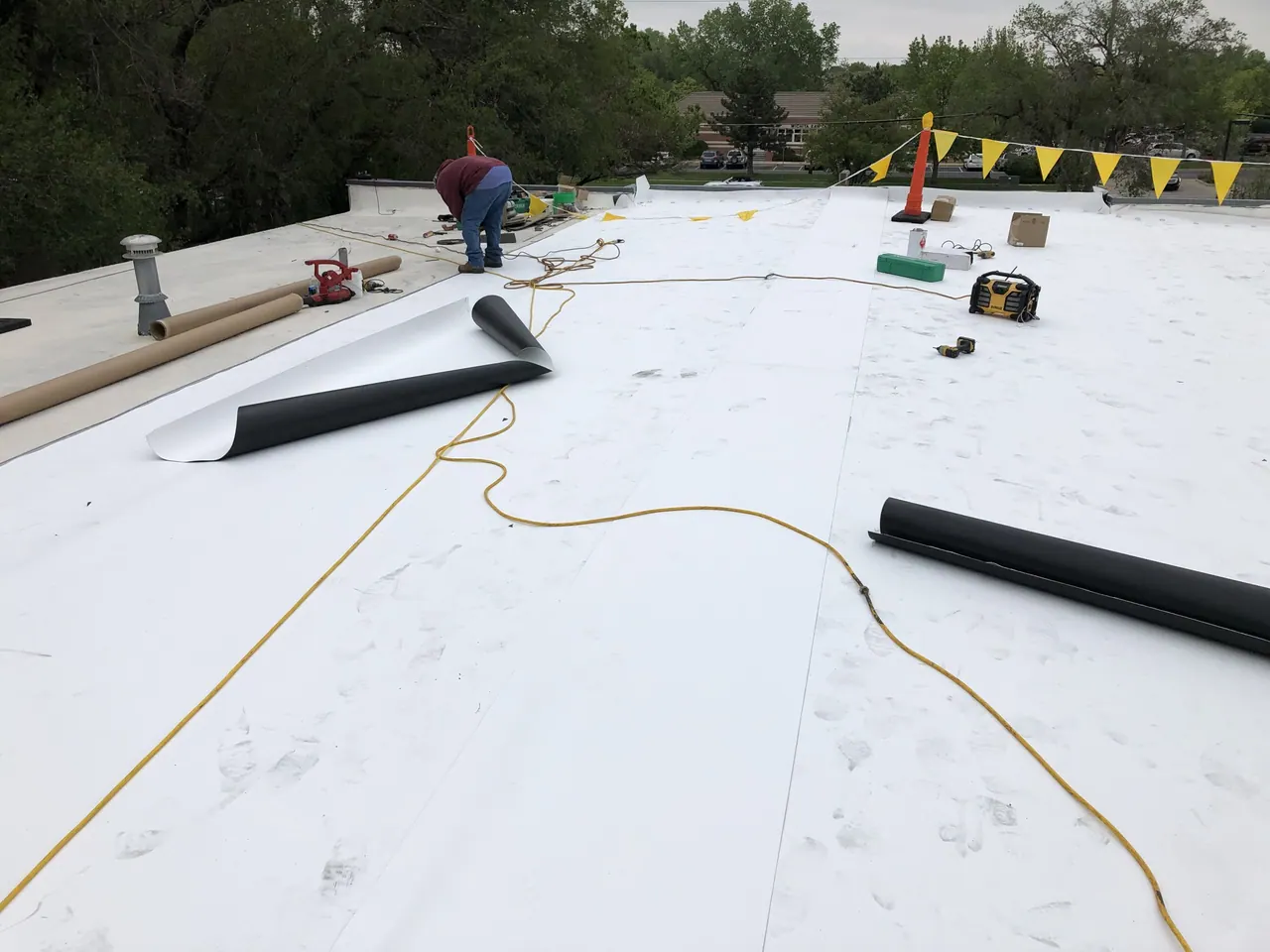
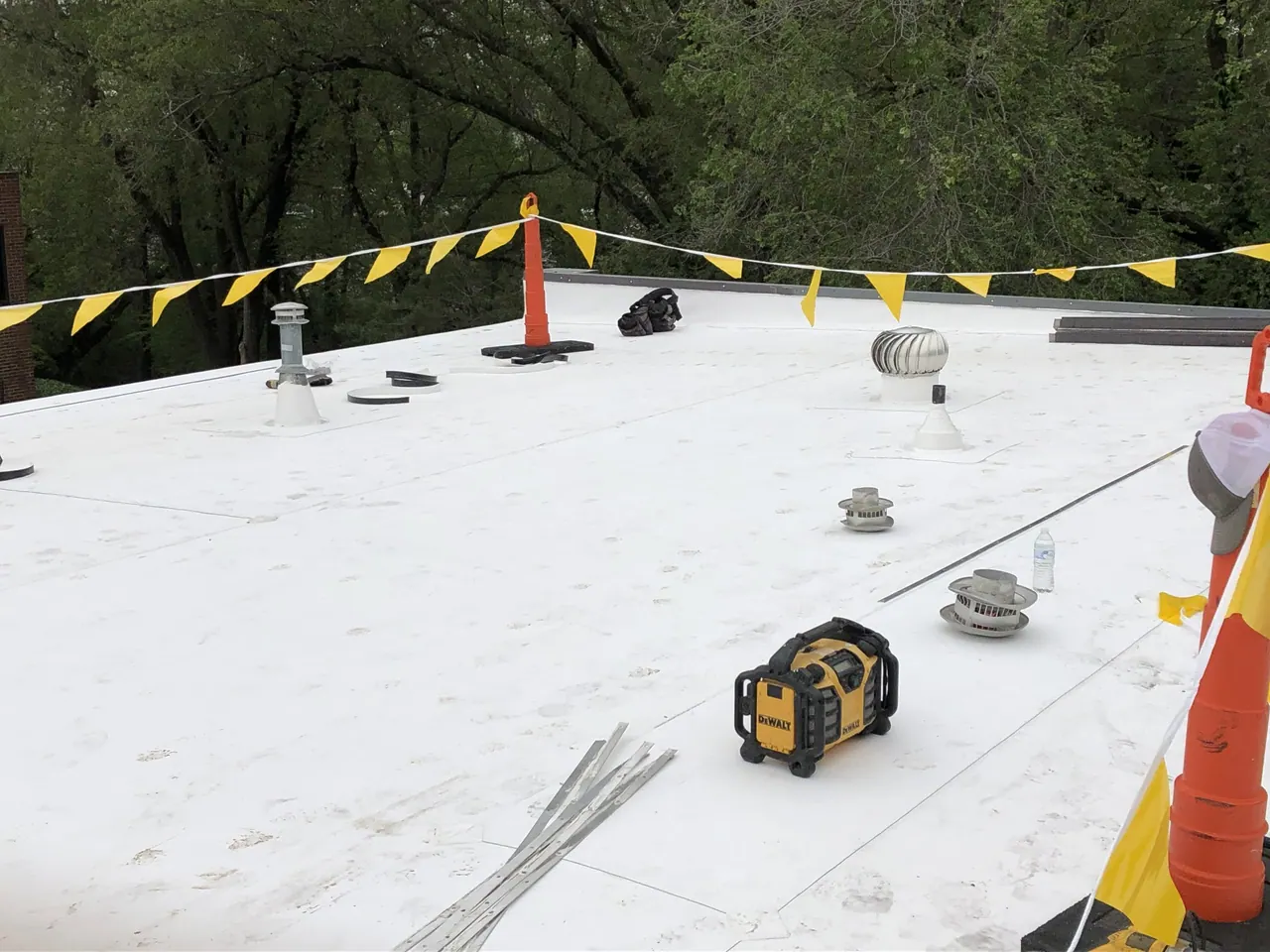
Insulation boards staged on the deck, then a white single-ply membrane rolled out, fastened and seamed across a low-slope commercial roof.
How Do Flat Roof Drainage Problems Start on Wichita Buildings? The honest answer depends on your roof’s age, material and the damage we can document. A free inspection from Wichita Roofing Pros gives you photos, a plain-English explanation and a written next step — with no obligation. Hablamos Español.
Schedule a Free Roof InspectionCall (316) 742-1900Frequently Asked Questions About Flat Roof Drainage in Wichita
How often should flat roof drains be cleaned in Wichita?
Flat roof drains in Wichita should be cleaned at minimum twice per year: once in early spring before storm season begins and once in late fall after cottonwood and leaf debris has settled. Buildings surrounded by mature trees or located near the Arkansas River corridor where cottonwood seed volume is high may need cleaning three to four times annually. Blocked drains discovered after a storm event should be cleared immediately to prevent continued ponding.
Can flat roof drainage problems cause interior ceiling damage in Wichita buildings?
Yes. Persistent ponding water finds entry points through membrane seams, drain collar failures, and parapet flashing gaps. Once water enters the roof assembly, it migrates laterally within insulation layers and can appear as ceiling staining or wet insulation far from the actual roof leak point. Wichita property owners often discover drainage-related interior damage weeks after the causative rain event, making source identification difficult without a professional moisture scan.
What is the typical cost of flat roof drain repair in Wichita, KS?
Flat roof drain repairs in Wichita generally range from $300 to $1,200 for drain collar replacement or reseal work on a single drain. If the repair involves cutting out and replacing damaged membrane around the drain basin, costs rise to $600 to $2,000 depending on the membrane type and the extent of water-damaged substrate beneath it. Major drainage corrections involving re-sloping or adding overflow scuppers are priced as larger scope projects requiring individual estimates.
Does FEMA offer guidance on commercial roof drainage design for flood-prone areas?
Yes. The Federal Emergency Management Agency publishes technical guidance on building design in flood-prone areas, including roof drainage design considerations for commercial properties. Wichita properties in or near FEMA-designated Special Flood Hazard Areas along the Arkansas River and its tributaries should review applicable FEMA flood zone requirements, as these can affect roof drainage system specifications and insurance requirements. Visit FEMA.gov for current flood map resources and building guidance.
How does a roof’s age affect flat roof drainage performance in Wichita?
As flat roofs age, thermal cycling gradually compresses insulation layers unevenly, creating low areas that were not present when the roof was installed. Membrane shrinkage around drains and walls also becomes more pronounced after 10 to 15 years. A roof that drained adequately when new can develop chronic ponding zones over time simply due to material movement without any single failure event. Annual documentation of ponding locations helps track whether new low areas are developing as the roof ages.
Can a TPO roof be repaired?
Yes. Seams and punctures can often be repaired when the rest of the membrane is sound.
Do you work with property managers?
Yes. We provide documented inspections and prioritized recommendations.
TPO or modified bitumen?
It depends on the building, foot traffic and budget. See our TPO vs. modified bitumen guide.




