Quick answerA complete roof maintenance budget for a Wichita commercial property has three distinct cost layers: routine maintenance, responsive repair, and reserve accumulation for eventual capital replacement. Many property managers budget only for the first layer and absorb the other two as unplanned variances.
Roof maintenance budgeting is one of the most underfunded line items in Wichita commercial property management. Property managers consistently rank unplanned roof repairs among the top three budget disruptions in any given year, yet most operating budgets allocate little or nothing to proactive roof maintenance that would prevent many of those emergency calls. Building a defensible, realistic roof maintenance budget for a Wichita commercial property requires understanding the local cost drivers, the age-based reserve requirements, and the framework for distinguishing routine maintenance from capital expenditure. This guide provides a practical budgeting structure that Wichita property managers can apply across their portfolios.
What Are the Core Cost Components of a Commercial Roof Maintenance Budget in Wichita?
A complete roof maintenance budget for a Wichita commercial property has three distinct cost layers: routine maintenance, responsive repair, and reserve accumulation for eventual capital replacement. Many property managers budget only for the first layer and absorb the other two as unplanned variances. A well-structured budget addresses all three explicitly, which reduces variance and improves cash flow predictability across the portfolio.
Worried about your roof?Wichita Roofing Pros will check it for free and explain what we find in plain words.Book a Free Inspection or call (316) 742-1900
Routine maintenance costs include semi-annual inspection fees, drainage cleaning, minor sealant work, and written condition reporting. For most Wichita commercial buildings under 15,000 square feet, routine maintenance runs between $800 and $2,000 annually depending on roof system complexity. Responsive repair costs — work triggered by storm events, leak reports, or inspection findings — should be estimated as a percentage of replacement value: typically one to two percent per year for roofs under 15 years old, rising to two to four percent for roofs in the 15- to 25-year range. Capital reserve accumulation requires projecting the replacement cost of each roof section and amortizing it over the remaining estimated service life. The commercial roofing team at Wichita Roofing Pros provides written condition reports and replacement cost estimates that support this reserve calculation for Sedgwick County properties.
How Do Wichita’s Storm Events Affect the Responsive Repair Budget Line?
Storm-related roof repair costs are the most volatile element of any Wichita property maintenance budget. Sedgwick County averages multiple severe weather events per year that produce hail or straight-line winds capable of causing measurable roof damage. After major regional hail events — the kind documented by the National Weather Service Wichita office — property managers receive simultaneous damage reports across their portfolio, and roofing contractor availability tightens significantly. This simultaneous demand spike is itself a cost driver: emergency scheduling during peak post-storm periods can add 15 to 30 percent to the cost of otherwise routine repair work.
The practical budget response to Wichita’s storm environment is to maintain a dedicated storm response reserve separate from the routine maintenance budget line. A reserve of $3,000 to $8,000 per property, scaled to roof area and age, provides liquidity for post-storm assessments and emergency repairs without forcing property managers to seek emergency budget approvals that delay critical work. Properties whose roofs carry current documented condition baselines can also process insurance claims more efficiently after hail events, reducing the out-of-pocket component of storm repair costs. Contact Wichita Roofing Pros roof repair to establish a documented condition baseline before storm season.
Many property managers budget only for the first layer and absorb the other two as unplanned variances.
What Is a Reasonable Per-Square-Foot Roof Maintenance Budget for Wichita Commercial Properties?
Industry benchmarks for commercial roof maintenance budgeting provide a useful starting framework for Wichita property managers. The Building Owners and Managers Association and roofing industry research consistently support a maintenance and repair budget of $0.10 to $0.25 per square foot per year for commercial flat roofs in reasonable condition. This range reflects routine maintenance cost plus an allowance for responsive repairs but does not include capital reserve accumulation, which should be tracked separately.
For a 20,000-square-foot Wichita commercial flat roof in good condition, this benchmark produces a maintenance and repair budget of $2,000 to $5,000 annually. For the same building with a roof in the 15- to 20-year age range, the appropriate budget rises to $0.20 to $0.40 per square foot — $4,000 to $8,000 — reflecting the higher frequency and cost of age-related repairs. These are planning benchmarks, not guarantees; actual costs in any given year can fall well below or above the range depending on storm activity and roof condition trajectory. A Wichita roof inspection produces the specific condition data needed to refine these benchmarks for individual buildings.
How Should Property Managers Structure Capital Replacement Reserves for Roofing?
Capital reserve accumulation for roof replacement is the budget component most commonly absent from Wichita commercial property operating budgets. The consequence of this gap is predictable: when a roof reaches end of service life, the property owner faces a capital expenditure of $5 to $12 per square foot for TPO or EPDM replacement on a building that has no accumulated reserve, forcing emergency financing or deferred replacement decisions that allow interior damage to accumulate.
A straightforward reserve methodology calculates the estimated replacement cost of each roof section, divides it by the remaining expected service life in years, and funds that annual amount into a dedicated reserve account. For a 20,000-square-foot Wichita commercial flat roof with an estimated replacement cost of $180,000 and 12 years of remaining service life, the annual reserve contribution is $15,000. This amount should be reviewed and adjusted after every professional condition assessment, since repair interventions can extend service life and storm damage can accelerate end of life. Property managers overseeing portfolios benefit from maintaining a roof asset register that tracks replacement cost estimates, service life projections, and annual reserve targets for every building. The Wichita commercial roofing team can provide written replacement cost estimates as part of a condition assessment engagement.
What Maintenance Activities Deliver the Best Return on a Tight Roofing Budget?
When budgets are constrained, prioritizing the highest-ROI maintenance activities maximizes protection per dollar spent. For Wichita commercial flat roofs, the maintenance activities with the highest return are those that prevent the most expensive failure modes. Drainage system maintenance — clearing drains, testing flow, and probing drain collars — prevents the interior water damage events that are orders of magnitude more expensive than the maintenance itself. Penetration seal inspection, particularly at HVAC curbs, catches the most common leak entry point before water reaches insulation and deck.
- Annual drainage cleaning and flow testing — Highest ROI activity on any flat roof; prevents interior damage events.
- Penetration seal inspection at HVAC curbs — HVAC connections are the leading source of commercial roof leaks on Wichita buildings.
- Parapet wall cap flashing inspection — Water entry through cap flashing is slow and chronic, producing widespread insulation saturation before becoming visible.
- Post-storm rapid assessment — A prompt damage assessment after a Wichita hail event supports insurance claims and identifies urgent repairs before they worsen.
- Seam lap spot-checking — Detecting seam separation early allows $150 to $300 re-welds that prevent $5,000 membrane section replacements.
A maintenance program focused on these five activities provides significant protection even on a budget that cannot support a full semi-annual inspection program. Review commercial roofing maintenance services to understand full-program options.
How Should Property Managers Evaluate Bids for Commercial Roof Maintenance Contracts?
Commercial roof maintenance contract bids for Wichita properties vary widely in what is included, and price comparison without scope comparison produces misleading results. Before comparing bid prices, property managers should confirm that each bid specifies: the exact number of annual visits, what work is included in each visit versus billed separately, the format and contents of the condition report delivered after each visit, the response time commitment for post-storm assessments, and whether the maintenance agreement includes priority scheduling for repairs identified during maintenance visits.
A maintenance contract that includes detailed written condition reports after every visit provides value beyond the immediate inspection because it creates the documentation record that supports insurance claims, warranty claims, and future capital planning. A lower-priced contract that provides only a verbal debrief or a simple checklist form does not deliver this documentation value. For Wichita property managers overseeing multiple buildings, standardizing on a single maintenance contractor who understands the local storm environment and provides consistent documentation formats across the portfolio creates significant administrative efficiency. The Sedgwick County roofing service area page outlines coverage for multi-property portfolios in the greater Wichita area.
What Tax and Accounting Considerations Apply to Roof Maintenance Budgets?
The distinction between repair and capital expenditure for roofing work has direct tax implications for Wichita commercial property owners that affect how maintenance and repair costs should be categorized in the operating budget versus the capital budget. Under IRS Tangible Property Regulations, routine repair and maintenance work that does not materially extend the useful life or add capacity to the roof can generally be expensed in the current tax year. Replacement of a full roof section or the entire roof system is typically capitalized and depreciated over the asset’s tax life.
This distinction means that the maintenance-versus-repair-versus-replacement decision has budget implications beyond the immediate cash outlay. Property managers should work with their tax and accounting advisors to ensure that roof-related expenditures are coded appropriately from the beginning of the project, since reclassification after the fact creates administrative burden and potential compliance risk. A roofing contractor who provides clear, line-itemized invoices with specific descriptions of work performed makes this accounting classification straightforward. Wichita Roofing Pros provides detailed written invoices that support accurate expense categorization for commercial property accounting purposes. The team has worked across the full range of commercial property types in Sedgwick County, providing the local project history that informs realistic budget guidance for this specific market.
Why commercial roofs need a maintenance plan here
Inspections in spring and fall, plus after major storms, catch open seams, clogged drains and punctures before they turn into interior leaks and business interruptions.
Commercial roof inspection checklist for Wichita property owners
Property managers can track these items between professional inspections.
- Water ponding more than 48 hours after rain
- Open or lifted seams
- Blisters, cracks or shrinkage in the membrane
- Clogged drains, scuppers or gutters
- Damage around HVAC curbs and penetrations
- Loose or damaged edge metal
- Interior ceiling tile stains
- Debris or foot traffic damage near equipment
How we inspect a commercial roof
A consistent process gives owners and managers a clear budget picture.
- Review history. Age, past repairs and leak locations.
- Walk the field and perimeter. Seams, edges, flashings and equipment.
- Check drainage. Drains, scuppers and ponding areas.
- Document. Photos and notes for each issue.
- Prioritize. Now, soon and monitor, with written pricing.
Commercial roof mistakes that shorten roof life
- Skipping post-storm inspections
- Letting drains clog
- Allowing unprotected foot traffic around equipment
- Patching over wet insulation
- Replacing a roof that a repair would have extended
What affects commercial roofing cost
Roof size, system type, insulation, number of penetrations, drainage changes, access and whether wet insulation must be removed. A maintenance plan spreads cost out and supports budgeting.
From our work: Commercial Membrane Roof
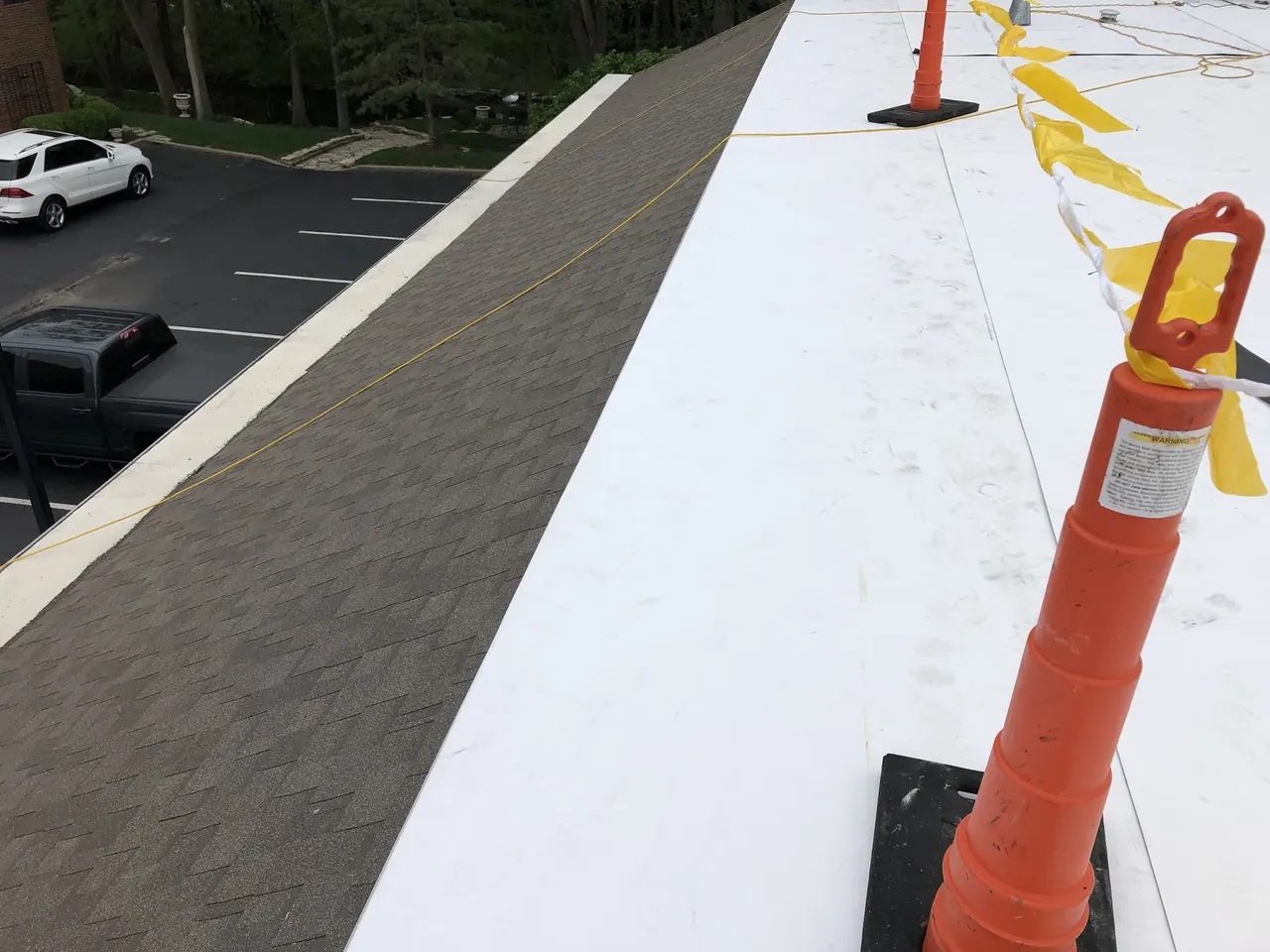
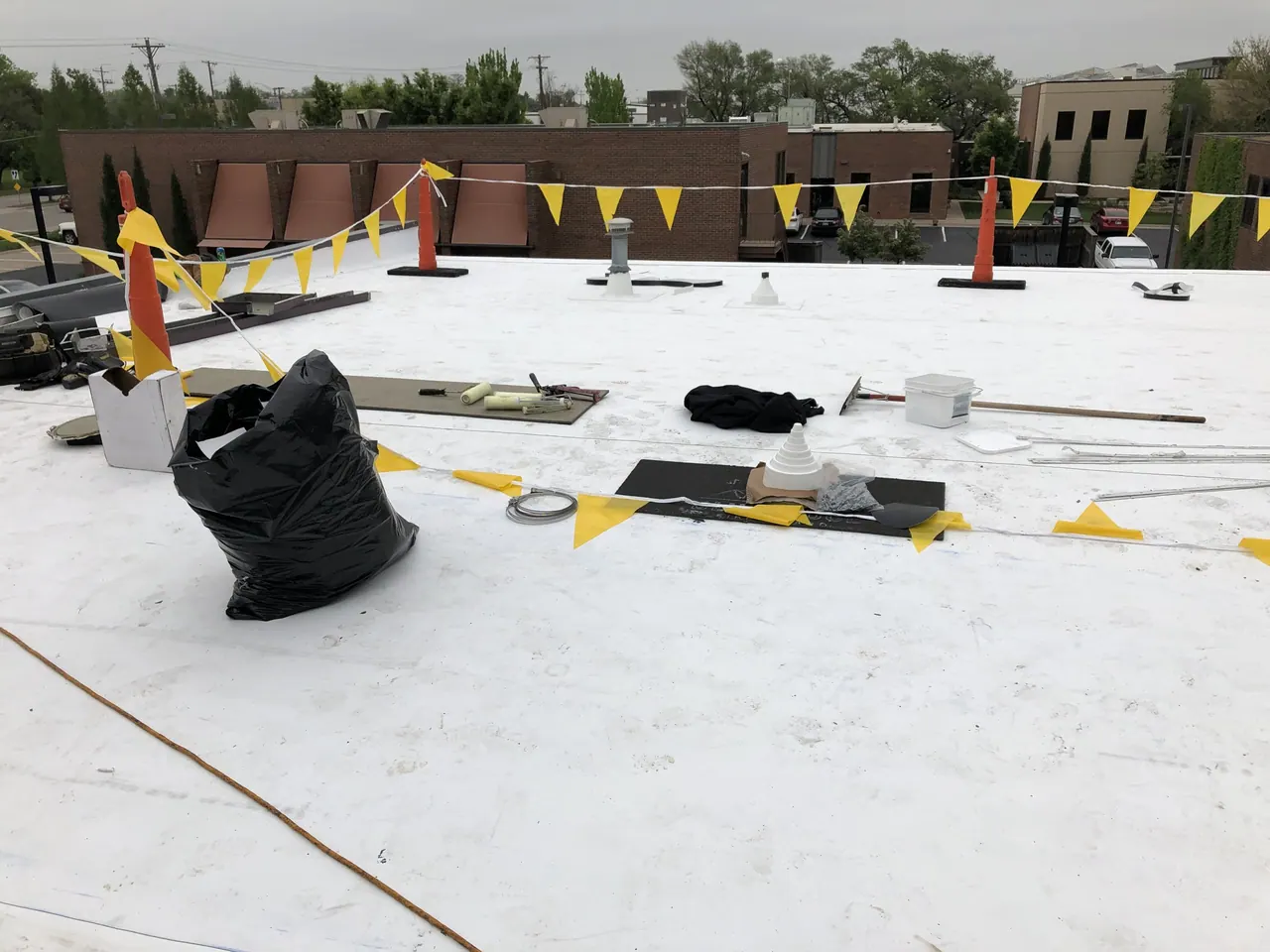
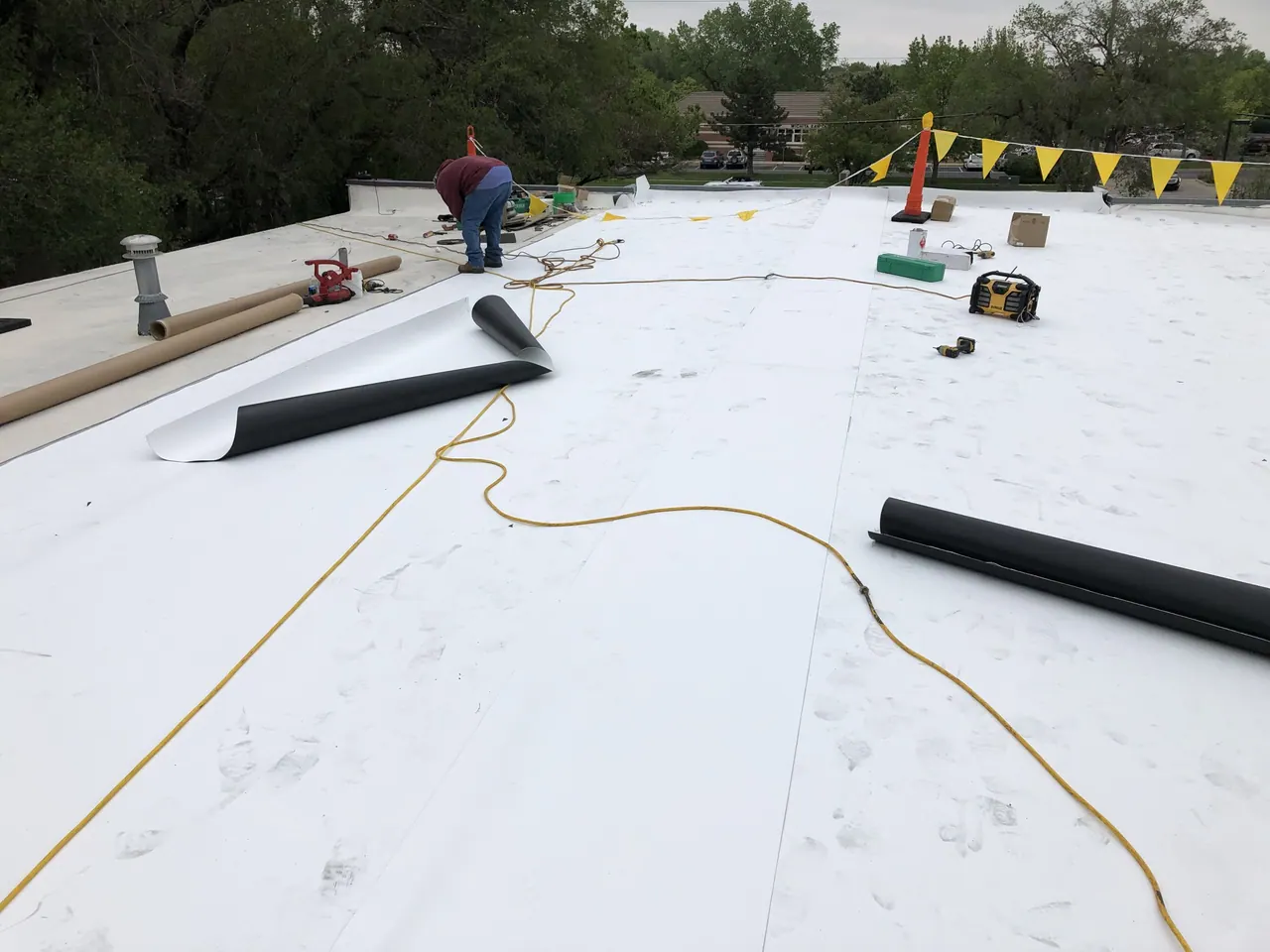
Insulation boards staged on the deck, then a white single-ply membrane rolled out, fastened and seamed across a low-slope commercial roof.
How Can Wichita Property Managers Budget for Roof Maintenance? The honest answer depends on your roof’s age, material and the damage we can document. A free inspection from Wichita Roofing Pros gives you photos, a plain-English explanation and a written next step — with no obligation. Hablamos Español.
Schedule a Free Roof InspectionCall (316) 742-1900Frequently Asked Questions About Roof Maintenance Budgets in Wichita
How much should a Wichita property manager budget per roof per year for maintenance?
A practical starting budget for Wichita commercial flat roof maintenance is $0.10 to $0.25 per square foot per year for routine maintenance and responsive repair combined, assuming the roof is in reasonably good condition and under 15 years old. Roofs aged 15 to 25 years should budget $0.20 to $0.40 per square foot. Capital replacement reserves should be calculated separately based on replacement cost divided by remaining service life years, then added to the operating maintenance budget for a complete picture of annual roofing cost.
What is the best time of year to schedule commercial roof maintenance in Wichita?
The two optimal windows for commercial roof maintenance in Wichita are late March through mid-April, before peak storm season begins, and October through early November, after leaf drop and before the first hard freeze. Spring timing allows repair of freeze-thaw damage and drainage clearing before May and June rainfall peaks. Fall timing clears drainage before winter ice formation and documents any summer storm damage before manufacturer warranty claim deadlines pass. Post-storm assessments should be scheduled promptly after any significant hail or wind event, regardless of season.
Should roof maintenance costs be in the operating budget or capital budget?
Routine maintenance costs — inspection fees, drain cleaning, minor sealant work, and small spot repairs — belong in the operating budget as recurring annual expenses. Larger repair projects that restore the roof to its designed condition but do not extend its useful life may also be expensed, depending on scope and IRS Tangible Property Regulation classification. Capital reserve accumulation for full replacement should be tracked separately as a capital account. Consult a tax professional familiar with commercial real estate for guidance specific to your property’s accounting structure.
Does FEMA flood zone designation affect roof maintenance requirements for Wichita buildings?
Properties in FEMA Special Flood Hazard Areas along Wichita waterways may face additional drainage performance requirements as part of floodplain management compliance. Buildings in designated flood zones should ensure their roof drainage systems discharge appropriately and do not contribute to drainage problems that affect neighboring properties. The FEMA flood map service allows property managers to verify their building’s flood zone designation and review applicable management requirements that may affect drainage system specifications.
How does the FORTIFIED commercial program affect roofing capital budget planning?
Commercial buildings that achieve FORTIFIED designation from the Insurance Institute for Business and Home Safety may qualify for reduced insurance premiums that offset a portion of the capital investment in a qualifying roof system. When planning a roof replacement capital budget in Wichita, property managers should compare the premium difference between a standard commercial roof and a FORTIFIED-qualifying system against the potential insurance premium reduction over the system’s expected service life. Visit fortifiedhome.org for current FORTIFIED commercial roof program details and insurer participation lists.
Is ponding water a problem?
Water that stays more than about 48 hours speeds up wear and should be evaluated.
Can a TPO roof be repaired?
Yes. Seams and punctures can often be repaired when the rest of the membrane is sound.
Do you work with property managers?
Yes. We provide documented inspections and prioritized recommendations.