
Quick answerThe most-cited benefit of gutter guards is reducing the frequency of gutter cleaning, but that is actually secondary to the more significant protection they provide: keeping gutters functional during and immediately after a storm. A clogged gutter during a heavy rain event does not just overflow at the downspout.
Gutter guards occupy an interesting middle ground in home maintenance discussions in Wichita. They are not a new product, but they have improved substantially in recent years, and the case for installing them before storm season is more straightforward than it used to be. The question for Wichita homeowners is not whether gutters need to be kept clear, but whether gutter guards are the right tool for your specific roof, tree situation, and maintenance tolerance.
This guide covers how gutter guards function, what types perform best in Kansas conditions, what they protect against beyond just cleaning frequency, and where their limits are. If you want a professional evaluation of your gutters and roof edge condition before making a decision, Gutter Guards in Wichita services are available from Wichita Roofing Pros.
Worried about your roof?Wichita Roofing Pros will check it for free and explain what we find in plain words.Book a Free Inspection or call (316) 742-1900
What Do Gutter Guards Actually Protect Against in Wichita?
The most-cited benefit of gutter guards is reducing the frequency of gutter cleaning, but that is actually secondary to the more significant protection they provide: keeping gutters functional during and immediately after a storm. A clogged gutter during a heavy rain event does not just overflow at the downspout. It allows water to back up under the eave edge, saturating the fascia board and potentially working under the first course of shingles or behind the drip edge flashing. This is called roof edge water infiltration, and it is a leading source of fascia rot and soffit damage in Wichita homes.
Wichita’s mature tree canopy in neighborhoods like College Hill, Riverside, Eastborough, and the older residential areas near the downtown core means many homes have significant deciduous tree coverage that drops leaves, seed pods, and small branches throughout spring and fall. During a severe thunderstorm, that debris volume increases substantially. A gutter that was partially clear before a storm can become completely blocked during a single heavy rainfall combined with wind-blown debris.
Gutter guards reduce the likelihood of this scenario by restricting large debris entry while allowing water to pass through or over the guard surface into the gutter channel. The practical result is that gutters stay functional through the bulk of storm season with less intervention. According to NOAA National Weather Service Wichita storm data, the Wichita metro receives heavy rainfall events multiple times per spring, making functional gutters during those events important for roof edge and foundation protection. Research from the IBHS hail and high-wind roof research program confirms that roof edge water management is a key factor in overall roof system performance during severe weather events.
What Types of Gutter Guards Work Best for Wichita Homes?
Four main gutter guard categories are used on residential homes in Wichita: micro-mesh, surface tension (reverse curve), screen or perforated inserts, and foam or brush inserts. Each handles debris differently and has distinct performance characteristics in Kansas conditions.
Micro-mesh guards use a fine stainless steel or aluminum mesh surface that allows water to pass through while blocking debris down to small seed pods and shingle granules. They are the most effective type for keeping gutters clean and are the best option for homes with trees that produce fine debris like cottonwood fluff, sweetgum balls, or small elm seed clusters. Micro-mesh is the premium option and costs more than screen inserts, but it requires the least maintenance after installation.
Surface tension or reverse-curve guards rely on water’s adhesion to the guard surface to direct water into the gutter channel while debris falls off the edge. These work well in moderate debris situations but can allow water to overshoot the gutter during very heavy rainfall rates. They are a viable mid-range option for homes with moderate tree coverage.
Screen or perforated inserts are lower-cost options that reduce large debris entry but allow smaller particles through and require periodic cleaning of the screen surface itself. Foam and brush inserts sit inside the gutter channel and trap debris within their structure, requiring removal and cleaning more frequently than surface-mounted options. For Wichita’s storm season volume, foam and brush inserts are generally not recommended as a long-term maintenance reduction strategy.
This guide covers how gutter guards function, what types perform best in Kansas conditions, what they protect against beyond just cleaning frequency, and where their limits are.

Do Gutter Guards Help Protect the Roof Edge and Fascia in Wichita?
Keeping gutters free-flowing directly protects the roof edge system. The fascia board, which is the vertical trim board to which gutters attach, is often the first wood component to rot when gutters overflow or hold standing water for extended periods. Once fascia rot begins, it compromises the gutter attachment point and can spread to the soffit above, creating a much larger and more expensive repair than the gutter cleaning that was deferred. Rotted fascia also reduces the capacity to properly seal the eave-to-roof connection, which is a water entry vulnerability during wind-driven rain.
Gutter guards that keep debris out reduce the standing water time in gutters after storms, which reduces the sustained moisture contact with fascia wood. This is a practical argument for gutter guards that goes beyond cleaning convenience, particularly for Wichita homes where spring storm season creates repeated heavy-rainfall events in close succession. A fascia board that stays relatively dry between storms has a substantially longer service life than one that holds debris-laden standing water repeatedly through May and June.
The roof edge drip flashing, which channels water from the shingle surface edge into the gutter, is also protected indirectly when gutters function properly. Overflow from a blocked gutter can back up behind drip flashing and under roofing underlayment at the eave, creating a hidden moisture path into the roof deck. This scenario is preventable with functioning gutters, which gutter guards support. See our Wichita Roofing Pros roof inspection page for information on how we assess eave and fascia condition as part of a complete roof evaluation.
Top 5 Factors to Consider Before Installing Gutter Guards in Wichita
- Tree type and debris volume. Homes under heavy cottonwood, oak, or elm canopy produce fine, high-volume debris that demands micro-mesh guards. Homes with minimal tree coverage may find that standard cleaning is sufficient without a guard system.
- Gutter condition before installation. Installing guards on gutters that already have damaged sections, improper slope, or loose hangers adds a layer of protection on a compromised system. Address any existing gutter issues before investing in guards.
- Roof pitch and rainfall rate. Very steep-pitch roofs produce high-velocity water runoff during heavy rain. Some surface-tension guard types allow water to overshoot the gutter on steep-pitch applications. Micro-mesh designs handle steep-pitch situations better than reverse-curve options.
- Maintenance reduction vs. elimination. Gutter guards reduce cleaning frequency but do not eliminate all maintenance. Fine debris can accumulate on the guard surface and require periodic clearing. Setting realistic expectations helps avoid dissatisfaction with a product that is performing correctly.
- Installation quality and compatibility with existing gutters. Gutter guard installation that improperly lifts shingle edges or inserts under flashing can create new leak points. Professional installation that maintains proper shingle and flashing geometry is important, particularly on older roofs where the shingle edge may already be fragile.
What Happens to Unprotected Gutters During Wichita’s Peak Storm Months?
May and June in Wichita are the months when the combination of moisture, instability, and wind shear produces the most frequent severe thunderstorm events. During this six-to-eight-week window, gutters on unprotected Wichita homes can cycle through debris accumulation and overflow multiple times. Each overflow event deposits moisture against the fascia, backflows under the drip edge, and sometimes pushes water behind the gutter attachment point where the hanger meets the fascia board.
Over the course of several storm seasons, this repeated moisture contact degrades painted wood fascia, causes screws and hangers to loosen, and can introduce persistent moisture to the roof deck edge. These problems compound quietly until the fascia requires replacement or the gutter pulls free. Gutter guards interrupt this cycle by keeping the gutter channel clear of the debris that enables blockage. Homes that have already had a fascia replacement or experienced gutter-related water damage are particularly good candidates for guard installation because the pattern that caused prior damage is likely to recur without intervention. Our Gutter Guards in Wichita service evaluates your specific gutter and fascia history as part of the assessment.

Are Gutter Guards Worth the Cost for Wichita Storm Season Preparation?
The cost-benefit calculation for gutter guards in Wichita depends largely on how you weight maintenance time against protection outcomes. Micro-mesh guards on a typical Wichita residential home run from several hundred to over a thousand dollars installed, depending on linear footage and gutter configuration. Against that upfront cost, consider the compounding protection value: functional gutters through every spring storm, reduced fascia exposure to moisture, and a lower likelihood of roof edge water infiltration events over the coming years.
For homeowners who climb ladders to clean gutters themselves, the safety benefit alone justifies consideration. Falls from ladders during gutter cleaning are among the more common home maintenance injuries. Reducing the frequency of that task from twice a year or more to an occasional screen wipe has practical safety value beyond the cost-benefit math.
For homeowners who pay for professional gutter cleaning, two cleanings per year at $150 to $200 per cleaning adds up to $1,500 to $2,000 over five years. Micro-mesh guards that reduce cleaning to once every other year can approach cost-neutrality within that timeframe while providing the additional fascia and roof edge protection benefits. The Wichita roofing service area evaluation includes gutter condition and guard suitability in any full roof assessment. Our team can walk through the specific options for your home’s configuration and tree situation.
Why gutters matter so much in Wichita
Wichita storms can drop a lot of rain in a short time. Gutters that are undersized, clogged or pitched wrong overflow at the corners, soak fascia boards and dump water at the foundation, which is where many “roof” problems actually begin.
Gutter options at a glance
The right choice depends on roof size, tree cover and budget.
| Option | Best for | Keep in mind |
|---|---|---|
| Seamless aluminum gutters | Most homes | Fewer joints means fewer leaks |
| Larger gutters and downspouts | Large or steep roofs, heavy rain | Moves more water off the roof |
| Gutter guards | Homes under trees | Reduces clogs and cleaning |
| Gutter repair | Newer systems with isolated issues | Reseal seams, reset hangers, adjust pitch |
How we evaluate a gutter system
Gutters, roof edges and fascia work together, so we look at all three.
- Check flow. Pitch, outlets and downspout placement.
- Inspect the edge. Drip edge, fascia and soffit condition.
- Look for overflow clues. Stains, erosion and splash marks.
- Size the system. Match capacity to roof area and pitch.
- Recommend. Repair, replace, add guards, or fix fascia first.
Gutter mistakes we see often
- Installing new gutters on rotted fascia
- Downspouts that end at the foundation
- Too few hangers for Kansas wind
- Skipping guards under heavy tree cover
- Replacing gutters right before a roof replacement without coordinating the drip edge
What drives gutter cost
Linear footage, number of stories, downspout count, gutter size, guards, and any fascia repair needed underneath. Coordinating gutters with a roof replacement can save a second trip. Pricing is provided in writing after the inspection.
From our work: Two-Tone Ranch Replacement
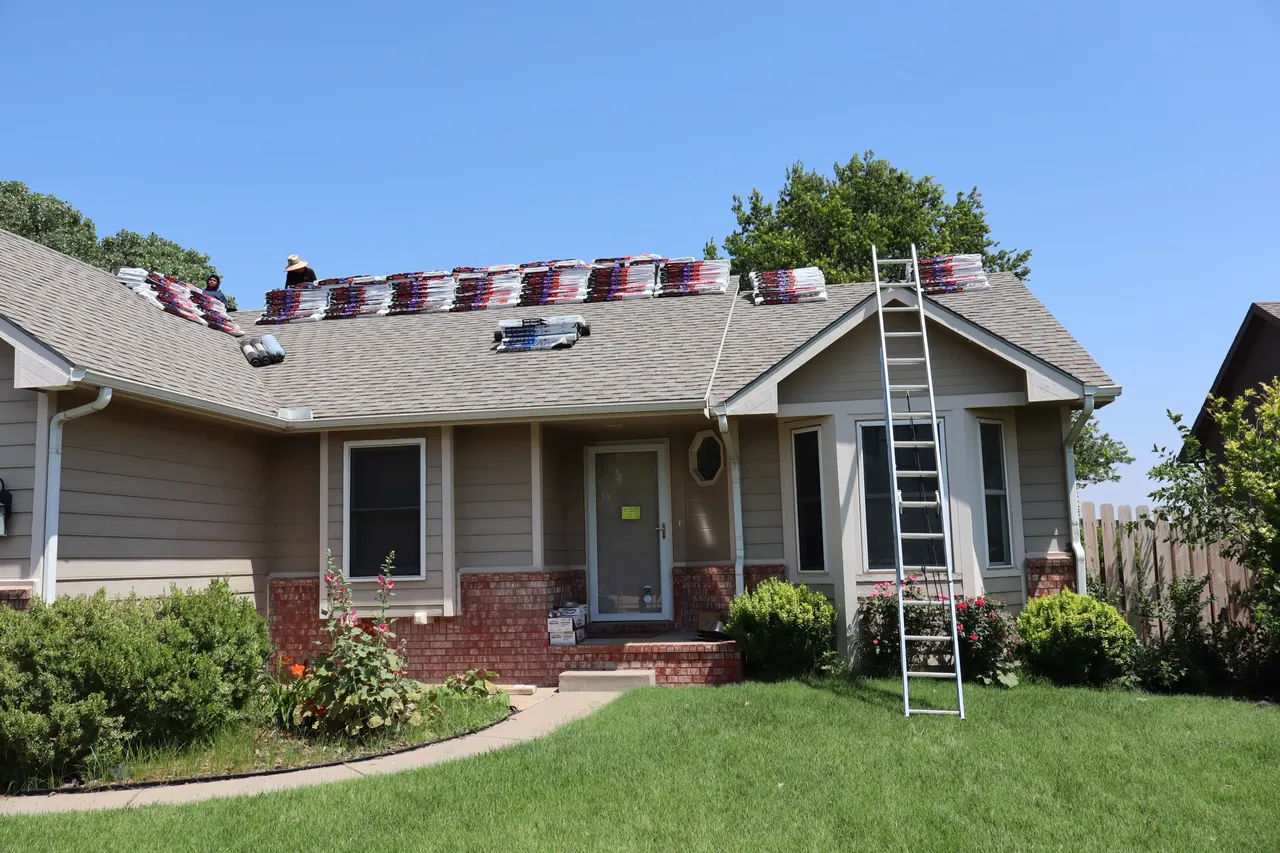
A brick and gray-siding ranch home during replacement: tear-off, crew setup, materials on site and the new architectural shingles going on.
Do Wichita Homes Need Gutter Guards Before Storm Season? The honest answer depends on your roof’s age, material and the damage we can document. A free inspection from Wichita Roofing Pros gives you photos, a plain-English explanation and a written next step — with no obligation. Hablamos Español.
Schedule a Free Roof InspectionCall (316) 742-1900Frequently Asked Questions About Gutter Guards in Wichita
Do gutter guards work during Wichita’s heavy spring rainstorms?
Quality micro-mesh guards handle normal heavy rainfall rates effectively. During extreme cloudburst events, any gutter system can be temporarily overwhelmed by sheer volume regardless of guards. The key is that guards prevent the most common failure mode: debris accumulation that blocks gutters before a storm arrives. A clear, properly sized gutter with guards handles heavy rain significantly better than a partially clogged gutter without them.
Can gutter guards cause ice dams in winter on Wichita homes?
Wichita’s winters are mild compared to northern Kansas, and true ice dam formation is uncommon at Wichita elevations. Some guard designs can collect minor ice at the gutter edge in extreme cold, but this is a minimal concern for most Wichita residential applications. Proper attic insulation and ventilation, which prevent the roof deck heat that drives ice dam formation, are more relevant protective measures than guard selection for Wichita’s climate.
Will gutter guards affect my roof warranty or shingle warranty?
Gutter guards installed on the gutter itself without disturbing shingles or flashing do not affect shingle manufacturer warranties. Guards that require insertion under shingles or flashing may create warranty concerns and should be evaluated carefully. Professional installation that maintains proper shingle geometry and does not alter the drip edge or flashing configuration is the standard to hold any installer to before work begins.
How do I know if my current gutters need replacement before adding guards?
Gutters with sections that have pulled away from the fascia, gutters with visible holes or rust spots, and gutters with incorrect slope that pool water rather than drain toward downspouts should be replaced or repaired before guard installation. Installing guards on damaged gutters wastes the guard investment and leaves the underlying problem unaddressed. A Gutter Guards in Wichita evaluation assesses existing gutter condition as the first step before recommending any guard system.
How often do micro-mesh gutter guards need cleaning in Wichita?
In a typical Wichita neighborhood with moderate tree coverage, micro-mesh guards generally need light surface cleaning once per year, typically in late fall after leaf drop is complete. Homes under heavy cottonwood or sweet gum trees may benefit from a quick spring surface brush as well. This compares favorably to unguarded gutters in similar tree situations, which typically require cleaning two to four times per year to stay functional through storm season.
Should I replace gutters before or after a new roof?
Usually after, or at the same time, so the drip edge and gutter line up correctly.
Are gutter guards worth it in Wichita?
For homes under trees, guards can significantly reduce clogs and overflow.
What are seamless gutters?
Gutters formed on site in continuous lengths, with joints only at corners and downspouts.




